


A CEO & CTO’s Guide to Building Global Moats in the Preventive Era
By Siddhant Singh, Founder & CEO of Webshark
Executive Introduction: The Compliance-as-a-Moat Strategy – Your 2026 HIPAA GDPR Guide
In 2026, the global HealthTech market is no longer divided by geography, but by trust protocols. As we move deeper into the era of preventive healthcare—driven by real-time vitals, AI diagnostics, and wearable integration—the data being handled is no longer just “sensitive”; it is “mission-critical,” as outlined in this 2026 HIPAA GDPR Guide.
For a CEO or CTO in the US or Europe, a security breach is not just a legal fine—it is a terminal event for company valuation. In 2025, the average cost of a healthcare data breach rose to $11.9 million. In 2026, with the enforcement of the EU AI Act, those stakes have doubled.
At Webshark, we have developed the “Compliance-First” Development Framework. For a detailed explanation of terms, please refer to Chapter VIII: Glossary of Critical HealthTech Compliance Terms. This white paper details the 2026 architecture required to build a global, high-scale, and hyper-secure HealthTech platform.
Chapter I: The 2026 Regulatory Convergence
1.1 HIPAA Modernization (The “Active Audit” Era) for 2026 Compliance
The US Department of Health and Human Services (HHS) has shifted its focus from “Policy” to “Performance.” In 2026, “Passive Compliance” (having a signed BAA and a firewall) is insufficient. Regulators now look for Active Audit Trails.
- Real-Time Access Monitoring: Every time a practitioner or user accesses ePHI, a non-repudiable log must be generated.
- Automated Threat Detection: Systems must now demonstrate the ability to identify “Impossible Travel” (e.g., a user logging in from New York and London within an hour) and automatically lock the record.
1.2 The EU AI Act & GDPR: Your 2026 Compliance Guide
For any US company scaling to Europe, 2026 is a watershed year. If your mobile health app uses AI to provide “Preventive Measures” (like our work on Webshark Health), it is likely classified as High-Risk AI.
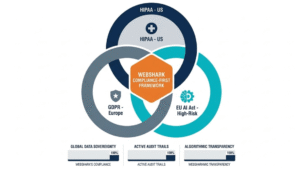
- Data Sovereignty: You cannot simply store EU patient data on a US-based AWS bucket. You must implement Regional Data Residency, ensuring that PII (Personally Identifiable Information) stays within the EEA (European Economic Area).
- Algorithmic Transparency: You must be able to explain why an AI recommendation was made to a patient—a requirement that goes far beyond standard HIPAA rules.
Chapter II: The Technical Blueprint – “Zero-Trust” Architecture
Strategic Note: This is where we prove our technical superiority to a CTO.
2.1 The “Hardened” Mobile Frontend (React Native/Flutter)
Most agencies build “wrappers.” We build “Enclaves.”
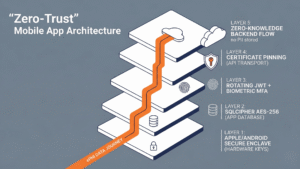
- Hardware-Backed Security: We utilize the Apple Secure Enclave and Android StrongBox. We store the private keys for data decryption within the hardware itself. Even if an attacker gains root access to the device, the keys remain mathematically unreachable.
- The “No-Persistence” Rule: Our framework ensures that no ePHI is ever stored in the standard AsyncStorage or SharedPreferences. We use SQLCipher with 256-bit AES encryption, where the key is generated per-session and wiped upon app-close.
- Screenshot & Screen-Recording Prevention: In 2026, malware that “scrapes” screens is common. Our code automatically obscures the UI when the app enters the background or when a screen-recording tool is detected.
2.2 The “Zero-Knowledge” Backend
We implement a Split-Identity Architecture.
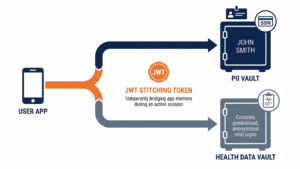
- Anonymization at Rest: The user’s identity (Name, Email, SSN) is stored in a separate, encrypted silo from their health data (Blood pressure, Lab results). The two are only “stitched” together in the volatile memory of the app frontend using a one-time-use token.
- FHIR v5 Integration: We leverage Google Cloud Healthcare API to ensure all data is stored in the FHIR (Fast Healthcare Interoperability Resources) format. This allows our clients to integrate with 90% of US hospital EHRs (Electronic Health Records) out of the box.
Chapter III: Cloud Orchestration Strategy: Aligning with the 2026 HIPAA GDPR Guide
Selecting a cloud provider in 2026 is a strategic business decision, not just a technical one. We guide our clients through a Multi-Cloud/Hybrid approach:
3.1 AWS HealthOmics (The Precision Medicine Powerhouse)
For startups focused on genomics and high-scale diagnostic data:
- Scalability: AWS HealthOmics allows us to process petabytes of genomic data without managing infrastructure.
- Compliance: It comes with pre-configured HIPAA eligibility and SOC 1/2/3 certifications.
3.2 Google Cloud (The Interoperability King)
If your goal is to be the “glue” between doctors and patients:
- Healthcare Natural Language API: We use this to turn unstructured doctor notes into searchable, compliant data.
- BigQuery for Health: Allows for population health analytics without moving sensitive data out of the compliant environment.
3.3 Azure for Health (The Enterprise/Europe Specialist)
For high-ticket European B2B clients:
- Microsoft Cloud for Healthcare: Offers the most robust tools for GDPR-compliant data residency and integration with existing hospital Microsoft 365 ecosystems.
Chapter IV: The Webshark “Preventive Compliance” Methodology
This section highlights your specific “Sales Engine” and internal app success.
4.1 Case Study: Webshark Health
Webshark Health isn’t just a product; it’s our Internal R&D Lab. * The Problem: How do you help users track vitals and insurance globally while staying compliant in multiple jurisdictions?
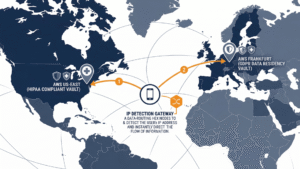
- The Webshark Solution: We built a Universal Compliance Gateway. This gateway detects the user’s IP and automatically switches the data storage protocol—US users go to AWS US-East (HIPAA), while EU users are routed to AWS Frankfurt (GDPR).
- Outcome: We achieved a “Security-First” deployment that allows for 99.99% uptime with zero data-bleeding across family management profiles.
4.2 The 24-Hour “Rapid Patch” Protocol
In the 2026 threat landscape, a vulnerability in a library like OpenSSL can appear at 2:00 AM.
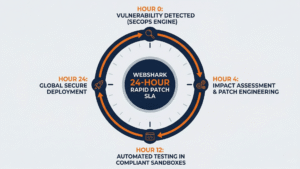
- Our Promise: Our SecOps Engine monitors every dependency in our clients’ codebases 24/7.
- Execution: We guarantee a Security Patch Deployment within 24 hours for critical vulnerabilities. For a CEO, this is the difference between a “minor update” and a “PR disaster.”
Chapter V: The ROI of High-Ticket Compliance
Strategic Note: This speaks directly to the CEO/Founder.
Investing in Webshark’s Compliance-First framework isn’t an “expense”; it’s a Value-Add for your Exit Strategy.
- Diligence Speed: During an acquisition or VC round, the “Technical Due Diligence” phase is where most deals die. A Webshark-built app passes this phase in days, not months.
- Lower Liability Insurance: Our clients report up to 40% lower premiums on Cyber Liability insurance because we provide the “Security-as-Code” documentation that insurers demand.
- Global Market Velocity: Most apps have to be “re-written” to enter the EU or the US. Our framework is “Global-Ready” from Day 1, saving the client $200k+ in future refactoring costs.
Chapter VI: Strategic Roadmap for 2026
A step-by-step for the reader.
- Audit Your Legacy Code: Does your app store PII in plain text?
- Map Your Data Flows: Where does your data go when it leaves the app?
- Implement Zero-Trust: Move away from simple password protection to Biometric-only JWT access.
- Adopt FHIR: Don’t build proprietary data silos; build for the interoperable future.
Chapter VII: Deep Dives & Technical Proof
Technical Deep Dive: The Mathematics of AES-256 in React Native
The choice of Advanced Encryption Standard (AES) with a 256-bit key (AES-256) is non-negotiable for ePHI in 2026. AES-256 is a symmetric block cipher, meaning the same key is used for both encryption and decryption. Its strength is rooted in the key size: a 256-bit key allows for 2^256 possible combinations. To put this in perspective, a brute-force attack on an AES-256 key would take longer than the estimated age of the universe, even using the most powerful supercomputers available today. In a React Native environment, this encryption is applied via wrappers (like SQLCipher for SQLite databases) that interface directly with native libraries (OpenSSL/LibreSSL). The critical component is the Key Derivation Function (KDF), such as PBKDF2 or Argon2. This function takes a user-provided password (or a key derived from the Secure Enclave) and stretches it into a cryptographically strong, 256-bit key. The KDF is computationally expensive, purposely slowing down the key generation process to thwart dictionary attacks. By leveraging hardware-backed KDFs within the Secure Enclave, Webshark ensures the decryption key never exists in accessible RAM, providing mathematical non-repudiation for data at rest on the mobile device.
Technical Deep Dive: FHIR v5’s Role in “Active Audit Trails”
Fast Healthcare Interoperability Resources (FHIR) is often discussed as a data format, but its true power lies in its compliance features, particularly in version 5. FHIR defines a specific resource type called AuditEvent. This resource is the foundation for HHS’s “Active Audit” expectations. An AuditEvent object mandates the structured recording of five critical elements every time data is accessed, created, updated, or deleted: the who (user identity/role), the what (the specific resource accessed, e.g., Patient/123), the when (timestamp), the where (source IP/device), and the outcome (success/failure). By strictly enforcing the use of FHIR v5 resources, every interaction with ePHI is not just logged, but logged in an internationally standardized, machine-readable format. This vastly accelerates the response to regulatory audits and powers Automated Threat Detection, as the system can rapidly query the AuditEvent repository to detect anomalies like “Impossible Travel” without complex log parsing. This commitment to FHIR AuditEvent is a core differentiator for Webshark’s compliance architecture.
Technical Deep Dive: Biometric JWT Access and Key Rotation
JSON Web Tokens (JWTs) are the standard for stateless authorization, but they pose a risk if compromised. Webshark’s “Biometric JWT Access” methodology solves this by moving the JWT signing process into a highly protected loop. Instead of the standard method where a user logs in with a password and receives a long-lived JWT, the user’s biometric scan (e.g., Face ID/Touch ID) acts as the final “proof-of-possession” to unlock a short-lived (e.g., 5-minute) token. The biometric data itself is never transmitted; the Secure Enclave merely confirms to the app that the user is present. Crucially, the system enforces aggressive Key Rotation. The JWT is refreshed every few minutes, and the refresh tokens themselves are single-use and invalidated immediately after use. If a token is stolen, its utility window is extremely narrow. This architecture—Biometrics authorizing a highly dynamic JWT flow—is essential for maintaining the Zero-Trust principle where the mobile device is treated as a potentially hostile environment.
Chapter VIII: Glossary of Critical HealthTech Compliance Terms
This glossary provides precise, high-density definitions for the acronyms and terms essential for strategic compliance planning in 2026.
- HIPAA (Health Insurance Portability and Accountability Act): A US federal law enacted in 1996 that sets standards for the protection of patient medical information. The core focus is on standardizing electronic health care transactions and establishing security, privacy, and integrity rules for Protected Health Information (PHI). Webshark focuses on the Security Rule (technical safeguards) and the Privacy Rule (patient rights and uses/disclosures).
- ePHI (Electronic Protected Health Information): Any Protected Health Information (PHI) that is created, stored, transmitted, or received in an electronic format. This includes all data from EHRs, mobile apps, remote patient monitoring devices, and cloud backups. The most rigorous security standards, including 256-bit AES encryption, are legally mandated for ePHI both at rest and in transit.
- BAA (Business Associate Agreement): A contract required by HIPAA between a HIPAA Covered Entity (like a hospital or insurer) and a Business Associate (like Webshark) that performs services involving the use or disclosure of ePHI. The BAA legally mandates that the Business Associate adhere to the same HIPAA safeguards as the Covered Entity. A signed BAA is a legal necessity but does not, in itself, guarantee technical compliance.
- GDPR (General Data Protection Regulation): A comprehensive regulation in EU law that covers data protection and privacy for all individuals within the European Economic Area (EEA). GDPR is much broader than HIPAA, covering all Personally Identifiable Information (PII) and imposing strict rules on data minimization, explicit consent, and the “right to be forgotten.” Fines for non-compliance can reach €20 million or 4% of annual global turnover.
- FHIR (Fast Healthcare Interoperability Resources): An international standard for exchanging electronic health care information, published by HL7. FHIR utilizes modern web technologies (RESTful APIs, JSON) to facilitate rapid, secure, and structured data sharing between healthcare systems (EHRs, labs, mobile apps). Webshark leverages FHIR v5 for its built-in compliance structures like the AuditEvent resource.
- HL7 (Health Level Seven International): A global, non-profit standards developing organization that provides a framework for the exchange, integration, sharing, and retrieval of electronic health information. FHIR is the latest, most flexible, and most secure data standard produced by HL7, superseding older formats like HL7 v2 and v3.
Chapter IX: High-Value FAQ for HealthTech Founders
This section addresses frequently asked questions from early-stage founders and CTOs, providing immediate clarity on complex compliance scenarios.
Q: Does HIPAA apply to my wearable fitness app if I only track steps and heart rate?
A: It depends on two factors: Who you are sharing data with, and What that data is used for. If your app collects data only for the user’s personal use (e.g., a pure fitness tracker with no clinician integration), it generally falls outside HIPAA. However, if your app integrates with an EHR, shares data with a doctor, or is funded by a healthcare provider (making you a Business Associate), HIPAA rules apply instantly. Furthermore, if you plan to launch in Europe, GDPR applies to all PII, regardless of whether it’s medical data. Webshark advises building as if HIPAA applies from Day 1 to prevent costly refactoring later.
Q: How long should I store patient logs and audit trails to remain compliant?
A: HIPAA mandates that records of all policies, procedures, and actions relating to the Security Rule must be retained for six years from the date of their creation or the date when they were last in effect, whichever is later. This includes log files, access attempts, risk analyses, and BAAs. For European users under GDPR, the rule is based on data minimization and purpose limitation. You must only store data as long as it is strictly necessary for the purpose it was collected. Webshark’s architecture manages these conflicting requirements through automated log retention and scheduled, auditable deletion protocols based on user region.
Q: If I use a public cloud provider like AWS or Google Cloud, are they automatically HIPAA compliant?
A: No. While AWS, Google Cloud, and Azure are HIPAA-eligible, compliance is a shared responsibility. The provider manages the security of the cloud (physical security, infrastructure patches), but the client (Webshark and your platform) is responsible for security in the cloud. This includes configuring encryption, identity access management (IAM), data flow segregation, and adhering to the signed BAA. Using an eligible cloud provider is a necessary first step, but without an expert like Webshark managing the configuration, your application remains non-compliant. Webshark provides a standard Business Associate Agreement (BAA) for all US-based engagements, ensuring your legal team is as satisfied as your technical team.
Q: What is the most critical difference between HIPAA and GDPR for a global company?
A: The primary difference is the scope of data subject rights. HIPAA grants patients the right to view, amend, and receive copies of their health information. GDPR goes further, granting the “right to erasure” (the “right to be forgotten”), the right to restrict processing, and the right to data portability. For a global app, handling a GDPR “right to be forgotten” request—which requires deleting a user’s PII from all systems, logs, and backups—is a vastly more complex operational challenge than any HIPAA requirement. Our Universal Compliance Gateway is designed specifically to handle these jurisdictional differences at the API layer.
Q: Is using an SSL/TLS certificate sufficient for “data in transit” compliance?
A: While mandatory, SSL/TLS (Secure Sockets Layer/Transport Layer Security) is only the minimum bar. For ePHI in transit, you must also consider the protocol version (TLS 1.2 or higher is required) and the cipher suite used. More importantly, secure transit is useless if the mobile client (the app) is not properly authenticated and authorized. Webshark couples strong TLS with two critical layers: client certificate pinning (preventing Man-in-the-Middle attacks) and high-frequency, biometric-backed JWT authorization to ensure end-to-end trust from the Secure Enclave to the Zero-Knowledge Backend.
Conclusion: Partnering with a Strategic Officer, Not Just a Vendor
At Webshark, we understand that you aren’t just building an app; you are building a business. Our role is to ensure that the technology powering your business is a fortress.
Whether you are a US startup seeking to disrupt the RPM (Remote Patient Monitoring) space or a European enterprise launching a preventive health platform, our Compliance-First Engine is your fastest path to market.
Ready to de-risk your HealthTech venture?
- Strategy & Consulting: Visit Webshark.tech
- Technical Implementation: Explore our Mobile Development Framework