

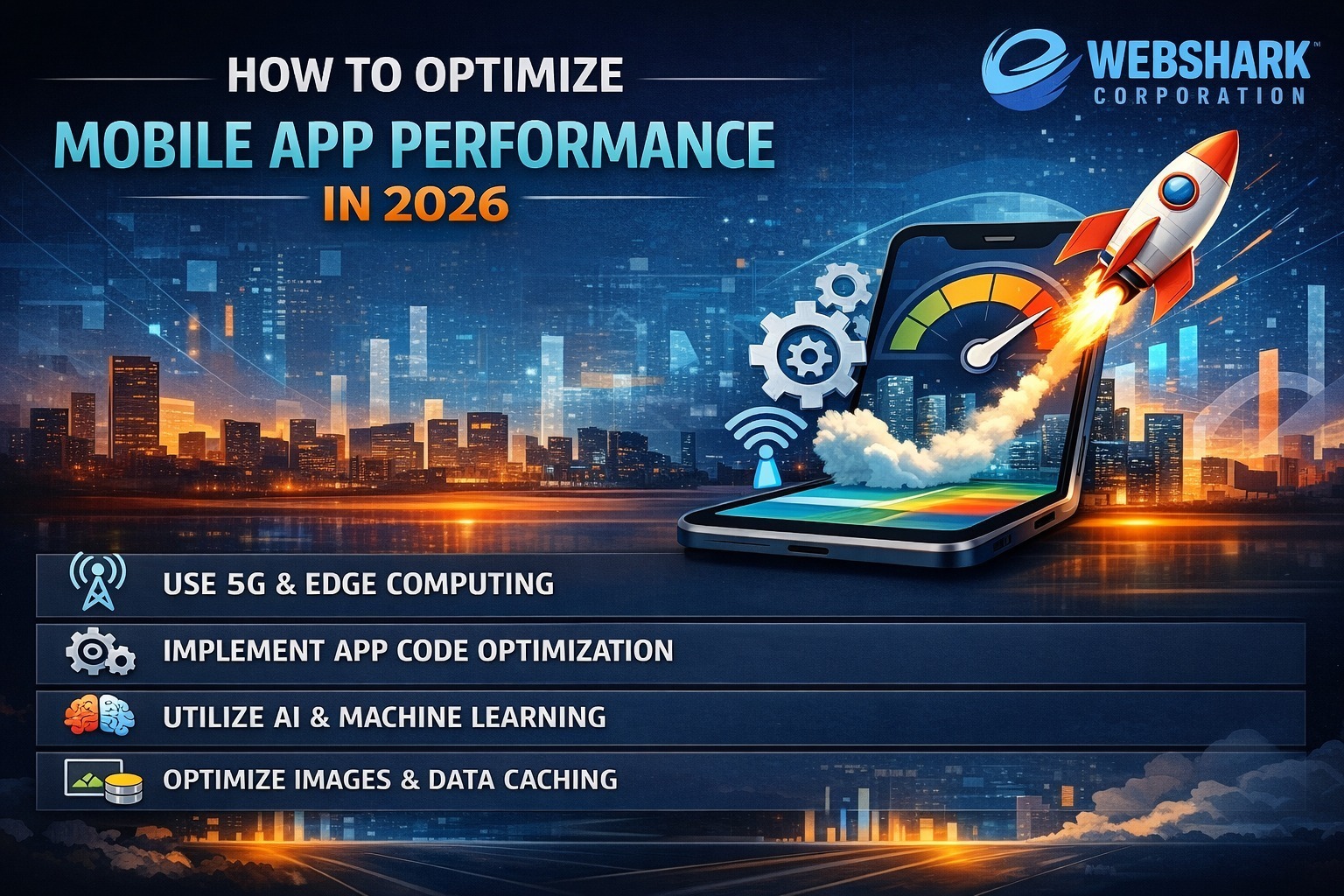

Introduction
Mobile apps have become the backbone of digital business success, but poor performance can send users running to competitors faster than you can say “loading screen.” With users expecting lightning-fast responses and seamless experiences, mobile app performance optimization isn’t just a technical nicety, it’s a business necessity.
Whether you’re working with a mobile app development company in USA or building in-house, understanding the latest performance optimization strategies is crucial for staying competitive in 2026’s demanding mobile landscape.
Why Mobile App Performance Matters More Than Ever
User expectations have reached new heights. In 2026, with 5G networks becoming standard and AI-powered experiences raising the bar, anything less than instantaneous feels broken. Poor performance doesn’t just frustrate users, it directly impacts your bottom line through:
- Higher uninstall rates and negative reviews
- Decreased user engagement and session times
- Lower conversion rates and revenue
- Damaged brand reputation
- Reduced app store rankings
Essential Performance Optimization Techniques for 2026
1. Leverage Advanced Code Optimization
Clean, efficient code forms the foundation of any high-performing app. In 2026, code optimization goes beyond basic best practices:
Minimize unnecessary computations by moving heavy processing to background threads. Your main UI thread should remain responsive at all times. Remove redundant code, unused libraries, and deprecated functions that bloat your app.
Implement lazy loading for components and features users might not immediately need. Why load everything upfront when you can load on demand? This approach dramatically reduces initial load times.
Use modern programming patterns like reactive programming and state management solutions that efficiently handle data flow. Companies like Webshark Corporation have pioneered techniques that reduce overhead while maintaining code readability.
2. Master Image and Media Optimization
Images and videos often account for the majority of an app’s data footprint.
Compress images intelligently using next-generation formats like WebP and AVIF that deliver superior compression without visible quality loss. Implement adaptive image loading that serves different resolutions based on device capabilities.
Utilize Content Delivery Networks (CDNs) to serve media from geographically distributed servers, reducing latency for users worldwide. Cache media assets locally after first download to eliminate redundant network requests.
Implement progressive loading for images where low-resolution placeholders appear instantly while high-resolution versions load in the background. This creates the perception of speed even when network conditions aren’t ideal.
3. Optimize Network Requests and API Calls
Network latency remains one of the biggest performance bottlenecks, even with 5G. Strategic API optimization is essential:
Batch API requests whenever possible instead of making multiple separate calls. One well-structured request beats five small ones every time.
Implement intelligent caching strategies that store frequently accessed data locally. Use cache-first approaches for static content and stale-while-revalidate patterns for dynamic data.
Adopt GraphQL or similar technologies that let you request exactly the data you need—nothing more, nothing less. Over-fetching data wastes bandwidth and processing power.
Use compression algorithms like Brotli or Gzip for API responses to reduce data transfer sizes by up to 70%.
4. Implement Smart Memory Management
Memory leaks and inefficient memory usage cause apps to slow down over time and eventually crash. Proper memory management keeps apps running smoothly:
Profile your app regularly using platform-specific tools like Android Studio Profiler or Xcode Instruments to identify memory leaks and excessive allocations.
Implement object pooling for frequently created and destroyed objects. Reusing objects reduces garbage collection overhead significantly.
Release resources promptly when they’re no longer needed. Bitmaps, database connections, and file handles should be closed as soon as possible.
Monitor memory usage patterns and set up alerts for abnormal spikes. A mobile app development company in USA with experience will have sophisticated monitoring systems in place.
5. Optimize Database Operations
Database queries can make or break app performance. Slow database operations create bottlenecks that ripple through your entire application:
Index frequently queried fields to speed up lookups exponentially. An unindexed query on a large dataset can take seconds; a properly indexed one completes in milliseconds.
Use asynchronous database operations to prevent blocking the main thread. Users should never see frozen interfaces while data loads.
Implement pagination for large datasets instead of loading thousands of records at once. Load what’s visible, prefetch what’s next, and defer everything else.
Choose the right database technology for your needs. SQLite works beautifully for structured data, while Realm or local storage solutions excel for other use cases.
6. Reduce App Size and Startup Time
Nobody wants to download a bloated app that takes forever to launch. App size optimization and fast startup times are critical for user acquisition and retention:
Remove unused resources through regular code audits. That experimental feature you never launched? Its assets are still inflating your APK or IPA.
Use dynamic feature modules (Android) or on-demand resources (iOS) to download features only when users need them. Your core app stays lean while remaining fully functional.
Optimize startup sequence by deferring non-critical initialization. Users should see your main interface within one second, even if background services take longer to initialize.
Implement code splitting to break your app into smaller chunks that load on demand. Modern frameworks make this increasingly straightforward.
7. Harness AI and Machine Learning for Predictive Optimization
2026’s most sophisticated apps use AI-powered optimization to predict user behavior and preload content intelligently:
Predictive prefetching analyzes usage patterns to load content users are likely to request next. When that prediction is right, the content appears instantly.
Adaptive performance tuning adjusts resource allocation based on device capabilities and current conditions. High-end devices get enhanced features while budget devices receive optimized experiences.
Intelligent caching powered by machine learning determines which data to cache and when to invalidate it, maximizing hit rates while minimizing stale data.
8. Optimize for Different Network Conditions
Not every user has consistent 5G coverage. Your app must perform gracefully on slower networks:
Implement progressive enhancement where core functionality works on any connection speed, with enhanced features available on faster networks.
Use adaptive bitrate streaming for video content that automatically adjusts quality based on available bandwidth.
Provide offline functionality for critical features. Users should be able to accomplish important tasks even without connectivity, with data syncing once the connection returns.
Show meaningful progress indicators during network operations. Users tolerate waiting much better when they understand what’s happening.
9. Conduct Rigorous Performance Testing
You can’t optimize what you don’t measure. Comprehensive performance testing reveals bottlenecks before users discover them:
Test on real devices across different manufacturers, screen sizes, and operating system versions. Emulators are useful but can’t replicate real-world conditions.
Simulate various network conditions including 3G, 4G, 5G, and flaky connections. Your app should degrade gracefully under poor conditions.
Perform load testing to understand how your app behaves under stress. What happens when thousands of users access simultaneously?
Monitor production performance continuously with tools like Firebase Performance Monitoring, New Relic, or AppDynamics. Real user data reveals issues testing might miss.
10. Adopt Platform-Specific Optimizations
iOS and Android have unique characteristics that require tailored approaches:
For iOS, leverage Metal for graphics-intensive tasks, implement proper view recycling in collection views, and use Combine framework for efficient reactive programming.
For Android, implement proper lifecycle management, use ViewHolder pattern with RecyclerView, leverage Jetpack Compose for efficient UI updates, and optimize for various screen densities.
The Role of Professional Development Teams
While these techniques are accessible to any development team, implementing them effectively requires experience and expertise. A seasoned mobile app development company in USA brings battle-tested optimization strategies and helps avoid common pitfalls.
Webshark Corporation and similar established firms have refined their optimization processes across hundreds of apps, giving them insights into what works and what doesn’t. They understand how to balance performance with feature richness, ensuring your app doesn’t sacrifice functionality for speed.
Measuring Success: Key Performance Metrics
Track these essential performance metrics to gauge optimization success:
- App launch time: Should be under two seconds for cold starts
- Screen rendering time: Target 60 FPS (frames per second) for smooth animations
- API response times: Aim for sub-second responses for critical operations
- Crash rate: Should remain below 1% of sessions
- Memory usage: Monitor average and peak consumption
- App size: Smaller is better, ideally under 50MB
- Battery consumption: Efficient apps preserve device battery life
Future-Proofing Your App Performance
Mobile technology evolves rapidly. Optimization and mobile app security isn’t a one-time task but an ongoing commitment:
Stay updated with platform releases and adopt new optimization APIs as they become available. Apple and Google continually introduce performance improvements in new OS versions.
Maintain a performance budget that sets limits for load times, app size, and memory usage. Review this budget quarterly and adjust as needed.
Foster a performance-first culture within your development team where optimization considerations influence architectural decisions from day one.
Invest in automation for performance testing and monitoring. Automated systems catch regressions before they reach production.
Conclusion
Optimizing mobile app performance in 2026 requires a holistic approach combining technical expertise, user-centered thinking, and continuous monitoring. From intelligent code optimization and efficient media handling to AI-powered predictive features and platform-specific enhancements, every detail contributes to the overall experience.
Users won’t remember your app’s innovative features if it’s slow, crashes frequently, or drains their battery. But they’ll absolutely remember—and recommend—an app that feels impossibly fast and effortlessly smooth.
Whether you’re building with an internal team or partnering with a mobile app development company in USA, prioritizing performance optimization delivers measurable returns through higher user satisfaction, better retention rates, and increased revenue. In 2026’s competitive mobile landscape, performance isn’t just a feature—it’s your app’s foundation for success.