

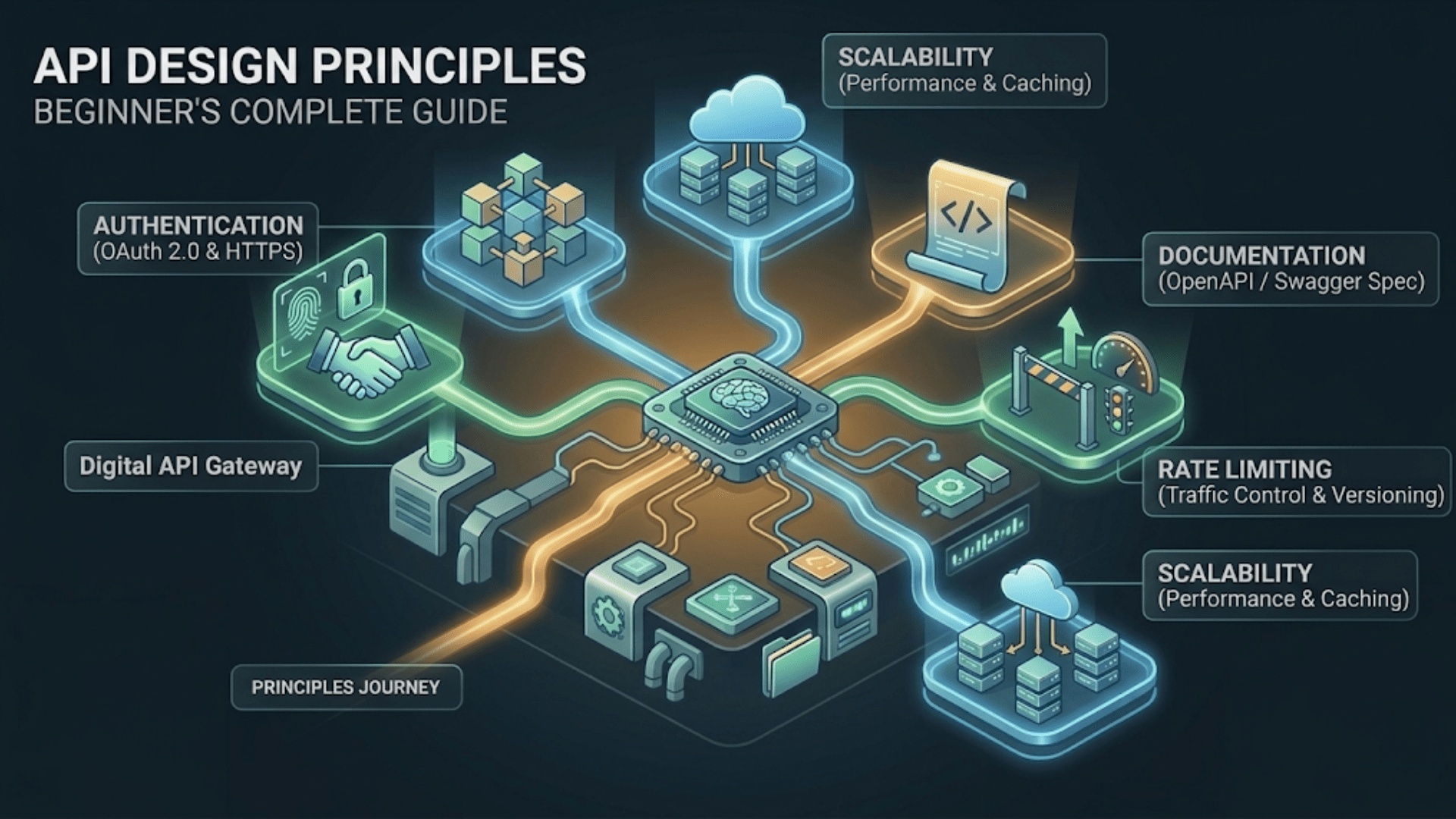

Picture this: You’re building a web application, and you need it to talk to a payment service, a weather feed, and a user database — all at once. How do they all communicate cleanly without chaos? The answer is an API design principles.
APIs (Application Programming Interfaces) are the backbone of modern software. But not all APIs are created equal. A poorly designed API can lead to confusing code, security holes, and frustrated developers. A well-designed one? It’s a joy to use.
In this guide, you’ll learn the core API design principles that separate good APIs from great ones. Whether you’re a developer just starting or a product manager looking to understand your tech team better, this guide is for you.
If you’re looking to build scalable and efficient solutions, working with a trusted software development company in USA can help you implement these API best practices effectively.
What Is an API? (Quick Refresher)
An API is a set of rules that lets two software applications talk to each other. Think of it like a waiter at a restaurant: you (the client) tell the waiter (the API) what you want, and they bring it back from the kitchen (the server).
There are many types of APIs — REST, GraphQL, SOAP, and more. But REST APIs are by far the most widely used in modern web development. According to RapidAPI’s 2023 State of APIs report, over 85% of developers use REST APIs in their projects.
That’s why most of the API design principles we’ll cover focus on RESTful API design guidelines — the gold standard for web APIs today.
Why API Design Principles Matter?
Bad API design has real consequences. Twitter’s original API had so many inconsistencies that third-party developers constantly complained. Stripe, on the other hand, is famous for its clean, developer-friendly API — and that reputation has helped it become a $50 billion company.
Good API design principles help you:
- Build APIs that are easy to understand and use
- Reduce bugs and integration headaches
- Scale your system without breaking existing code
- Keep your API secure from day one
- Attract and retain developers who use your product
💡 Pro Insight: The best APIs feel invisible. Developers shouldn’t have to struggle to understand how to call your endpoints. Clarity is a feature.
Core API Design Principles Every Developer Should Know
1. Follow REST API Design Principles
REST (Representational State Transfer) is a set of architectural constraints — not a protocol. When you design a RESTful API, you follow a set of rules that make your API predictable and scalable.
The six core REST constraints are:
- Client-Server separation — the UI and data logic are separate
- Statelessness — each request contains all the info needed to process it
- Cacheability — responses should define whether they can be cached
- Uniform Interface — consistent resource structure and naming
- Layered System — client doesn’t need to know backend architecture
- Code on Demand (optional) — server can send executable code
💡 Pro Insight: Statelessness is one of the most important REST API design principles. It makes your API easier to scale horizontally because no session data needs to be stored server-side.
2. Use Clear and Consistent API Naming Conventions
Naming your endpoints poorly is one of the fastest ways to frustrate developers. Good API naming conventions follow a few simple rules:
- Use nouns, not verbs, for resource names: /users not /getUsers
- Use plural nouns: /products not /product
- Use lowercase with hyphens: /user-profiles not /UserProfiles
- Reflect hierarchy in the path: /users/{id}/orders
Here’s a quick comparison:
❌ Bad Naming | ✅ Good Naming |
/getUser | /users/{id} |
/deleteProduct | /products/{id} |
/createOrder | /orders |
/getAllItems | /items |
3. Design Thoughtful API Request and Response Structures
Your API request and response design is the contract between your server and every developer who uses it. Keep it clean and consistent.
Best practices for requests:
- Use HTTP methods correctly: GET (read), POST (create), PUT/PATCH (update), DELETE (remove)
- Accept JSON as the default content type
- Validate inputs server-side — never trust client data
Best practices for responses:
- Always return a consistent JSON structure
- Include a status field and message for clarity
- Use standard HTTP status codes (200 OK, 201 Created, 404 Not Found, 500 Internal Server Error)
Example of a clean response:
{ “status”: “success”, “data”: { “id”: 42, “name”: “Jane Doe” }, “message”: “User retrieved successfully” }
4. Implement Strong API Security Best Practices
Security is not optional — it’s a core API design principle. A 2023 report from Akamai found that API attacks account for over 40% of all web application attacks in the US.
Essential API security best practices include:
- Authentication: Use OAuth 2.0 or API keys to verify who’s calling your API
- Authorization: Make sure authenticated users can only access what they’re allowed to
- HTTPS only: Never serve API responses over plain HTTP
- Input sanitization: Prevent SQL injection and XSS attacks
- Limit exposed data: Return only what the client actually needs
For API authentication methods, the most common choices are:
Method | Best For | Notes |
API Keys | Simple internal tools | Easy but less secure |
OAuth 2.0 | Public-facing APIs | Industry standard |
JWT Tokens | Stateless auth | Fast, scalable |
5. Use Smart API Versioning Strategies
Your API will change over time. New features get added. Old ones get deprecated. Without proper versioning, every update risks breaking the apps that depend on your API.
The most common API versioning strategies are:
- URL versioning: /v1/users, /v2/users — most popular, easy to understand
- Header versioning: Pass version in the request header (cleaner URLs, harder to test)
- Query parameter versioning: /users?version=1 — simple but less common
Stripe uses URL versioning and is widely praised for its approach. They give developers ample notice before deprecating any endpoint — a great model to follow.
💡 Pro Insight: Always start with v1 in your URL, even if you don’t plan to change anything. It’s much easier to add v2 later than to retrofit versioning into a live API.
6. Implement API Rate Limiting Strategies
Rate limiting controls how many requests a client can make in a given period. Without it, your API is vulnerable to abuse, DDoS attacks, and runaway bots.
Common API rate limiting strategies include:
- Fixed window: Allow X requests per minute/hour (simple, but can be gamed)
- Sliding window: Smoother enforcement over rolling time periods
- Token bucket: Allows bursts up to a limit, then throttles — used by AWS and Stripe
When you rate limit, always communicate it clearly in your response headers:
X-RateLimit-Limit: 1000X-RateLimit-Remaining: 450X-RateLimit-Reset: 1672531200
7. Handle Errors Gracefully — API Error Handling Best Practices
Nothing frustrates developers more than cryptic error messages. Good API error handling best practices make debugging fast and painless.
Your error responses should always include:
- A meaningful HTTP status code (400, 401, 403, 404, 422, 500)
- A machine-readable error code for programmatic handling
- A human-readable message explaining what went wrong
- Optional: A link to documentation for that error
Example of a great error response:
{ “status”: “error”, “code”: “INVALID_EMAIL”, “message”: “The email address provided is not valid.”, “docs”: “https://api.example.com/errors/INVALID_EMAIL” }
8. Prioritize API Documentation Best Practices
An API without documentation is like a product without a manual. Even the best-designed API will fail if developers can’t figure out how to use it.
API documentation best practices include:
- Use OpenAPI/Swagger spec to auto-generate interactive docs
- Include real request and response examples for every endpoint
- Document all error codes and what they mean
- Keep docs up to date with every release — stale docs are worse than no docs
- Add a quickstart guide so developers can make their first call in under 5 minutes
💡 Pro Insight: Stripe, Twilio, and Plaid are famous for developer-friendly docs. Study their documentation as a model for what great API documentation looks like.
9. Design for Scalability from the Start
Good API architecture principles mean thinking ahead. Designing scalable APIs from day one saves painful refactoring later.
Key strategies for designing scalable APIs:
- Support pagination for any endpoint returning a list of resources
- Use asynchronous processing for long-running operations
- Implement caching headers (ETag, Cache-Control) to reduce server load
- Design stateless endpoints so they can run on any server instance
- Use HATEOAS links to let clients discover related resources dynamically
10. Keep APIs Consistent and Backward-Compatible
Consistency is one of the most underrated API design standards. When everything follows the same patterns, developers can learn your API once and apply that knowledge everywhere.
Rules to maintain consistency:
- Use the same date format everywhere (ISO 8601: 2024-01-15T10:30:00Z)
- Use the same naming style across all fields (camelCase or snake_case — pick one)
- Never remove or rename fields in an existing response — add new fields instead
- Deprecate old behavior gracefully with clear timelines and migration guides
Quick-Reference: API Design Best Practices Checklist
✓ | API Design Best Practice |
☐ | Follow REST architectural constraints |
☐ | Use noun-based, plural, lowercase resource names |
☐ | Use correct HTTP methods (GET, POST, PUT, PATCH, DELETE) |
☐ | Return consistent JSON response structures |
☐ | Implement OAuth 2.0 or JWT for authentication |
☐ | Version your API from the start (e.g., /v1/) |
☐ | Add rate limiting with clear header communication |
☐ | Return meaningful HTTP status codes and error messages |
☐ | Publish and maintain up-to-date API documentation |
☐ | Support pagination for list endpoints |
☐ | Use HTTPS exclusively |
☐ | Maintain backward compatibility when making changes |
Frequently Asked Questions (FAQs)
Q1: What are the most important API design principles for beginners?
For beginners, focus on these five first: (1) use clear and consistent naming conventions, (2) follow REST API design principles, (3) return meaningful HTTP status codes, (4) implement authentication from day one, and (5) write documentation alongside your code — not after.
Q2: What’s the difference between REST API design principles and general API design principles?
General API design principles apply to any API type (REST, GraphQL, SOAP, gRPC). REST API design principles are specific to RESTful APIs and include constraints like statelessness, uniform interface, and resource-based URLs. In practice, most modern web APIs are REST-based, so the two sets of principles overlap heavily.
Q3: How do I handle API versioning without breaking existing users?
The safest approach is URL versioning (/v1/, /v2/). Never remove fields from an existing version — only add new ones. When you release a new version, maintain the old one for at least 12 months, communicate deprecation timelines clearly, and provide a migration guide. Companies like Stripe give developers years of advance notice before sunsetting old API versions.
Q4: What are the best API security best practices to implement first?
Start with the basics: enforce HTTPS for all traffic, require authentication on every non-public endpoint, implement rate limiting to prevent abuse, validate all input on the server side, and return only the minimum data needed in each response. These five practices alone will protect you from the vast majority of common API attacks.
Q5: Do I really need API documentation from the beginning?
Absolutely — yes. Even if you’re the only developer, documentation forces you to think through your API design more carefully. Use tools like Swagger UI or Postman to auto-generate interactive docs from your code. It takes less time than you think, and it pays dividends every time a teammate (or future you) needs to understand an endpoint.
Conclusion
Building a great API isn’t about following a rigid rulebook. It’s about making deliberate choices that make your API easy to use, hard to misuse, and ready to grow.
The API design principles we covered — from RESTful architecture and smart naming conventions to security, versioning, and documentation — are the foundation every great API is built on. Start with the basics, be consistent, and iterate over time.
Whether you’re building your first internal API or designing a public platform used by thousands of developers, these principles will guide you toward a cleaner, more reliable system.
Learn more with Webshark Corporation and explore insights on Webshark Blogs for a deeper understanding and practical implementation.