
App Development Cost in 2026: What You Need to Know ?

App Development Cost in 2026
January 9, 2026
SHARE


Key takeaways:-
    • Simple apps with basic features remain affordable, while complex apps with real-time functionality, AI, IoT, or advanced integrations significantly increase development costs.
    • Native iOS and Android apps cost more due to separate codebases, while cross-platform frameworks (like React Native or Flutter) reduce costs and development time in 2026.
    • Features such as AI personalization, data security, GDPR compliance, and advanced encryption are no longer optional—these raise upfront costs but improve long-term scalability and trust.
    • Webshark Corporation forward-thinking development approach delivers intelligent mobile solutions architected for sustained growth, enhanced customer lifetime value, and measurable ROI across the evolving USA marketplace.

The landscape of app development has evolved dramatically, and understanding the app development cost structure has become more crucial than ever for businesses looking to establish their digital presence. Whether you’re a startup founder or an established enterprise, knowing what to expect when budgeting for a mobile application can make the difference between success and financial strain.

The app development industry in 2026 continues to grow at an unprecedented rate, with global spending on mobile apps projected to exceed $600 billion. As technology advances and user expectations rise, the pricing models have become more complex yet more transparent. This comprehensive guide will walk you through everything you need to know about app development cost in 2026.

Understanding the Cost Components of App Development

When working with a mobile app development company in USA, it’s essential to understand that the final price tag isn’t just about coding. Multiple factors contribute to the overall investment, and breaking them down helps you make informed decisions.

Discovery and Planning Phase

Before a single line of code is written, successful projects invest heavily in planning. This phase typically includes market research, competitor analysis, user persona development, and feature prioritization. Companies like Webshark emphasize this foundational stage because it prevents costly revisions later in the development cycle.

The discovery phase usually accounts for 10-15% of your total budget and can range from $5,000 to $25,000 depending on project complexity. This investment pays dividends by ensuring everyone understands the project scope, target audience, and business objectives clearly.

Design and User Experience

UI/UX design has become the cornerstone of successful applications. Users in 2026 expect intuitive, beautiful, and accessible interfaces. The design phase encompasses wireframing, prototyping, visual design, and user testing.

Design costs vary significantly based on complexity and customization level. A basic app with standard design patterns might require $8,000 to $20,000, while a sophisticated application with custom animations, complex interactions, and extensive user testing can exceed $50,000.

Development and Programming

The development phase represents the largest portion of your budget. This is where your app comes to life through front-end development, back-end infrastructure, API integrations, and database architecture.

Native app development for both iOS and Android platforms typically costs more than cross-platform solutions but delivers superior performance. In 2026, technologies like Flutter, React Native, and Swift/Kotlin continue to dominate the development landscape.

Testing and Quality Assurance

Quality assurance ensures your app functions flawlessly across different devices, operating systems, and scenarios. This critical phase includes functional testing, performance testing, security testing, and user acceptance testing.

Budget approximately 15-20% of your development costs for comprehensive testing. Skipping or rushing this phase leads to poor user reviews, high uninstall rates, and expensive post-launch fixes.

Not Sure These Costs Apply to Your App?
Get a realistic, personalized cost estimate tailored to your specific idea, goals, and technical needs based on scope, features, and timelines, not vague or generic ranges.

Post-Launch Support and Maintenance

Many businesses overlook ongoing maintenance when calculating their total app development cost. Apps require regular updates for operating system compatibility, security patches, bug fixes, and feature enhancements. Annual maintenance typically runs 15-20% of the initial development investment, meaning a $100,000 app could cost an additional $15,000-$20,000 per year to maintain and keep competitive in the marketplace.
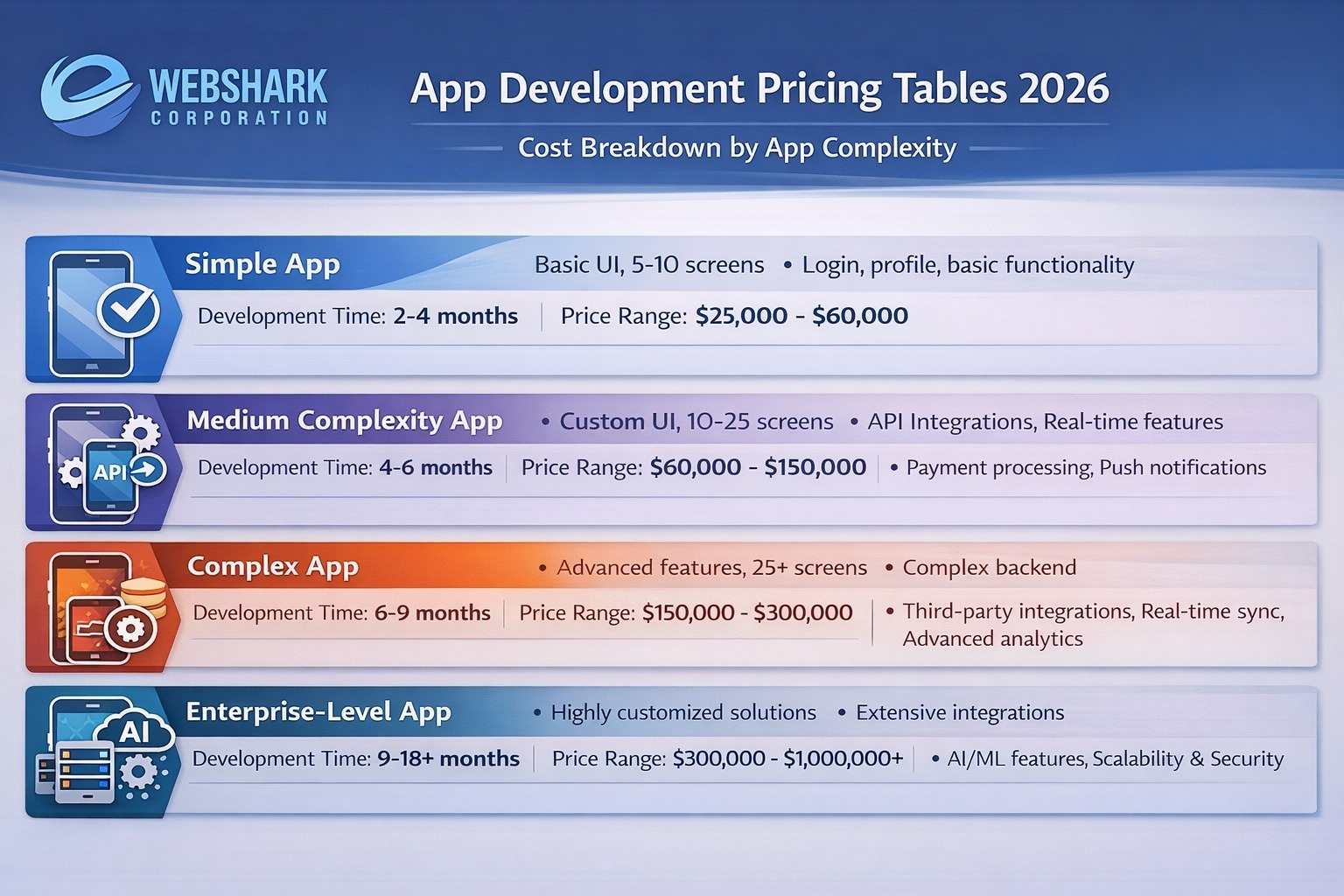

2026 App Development Cost Breakdown by ComplexityThe tables above provide a comprehensive breakdown of what you can expect to invest in your mobile app development project in 2026. These figures represent current market rates from reputable development firms across different regions.

Factors That Influence App Development Cost in 2026

Platform Selection Strategy

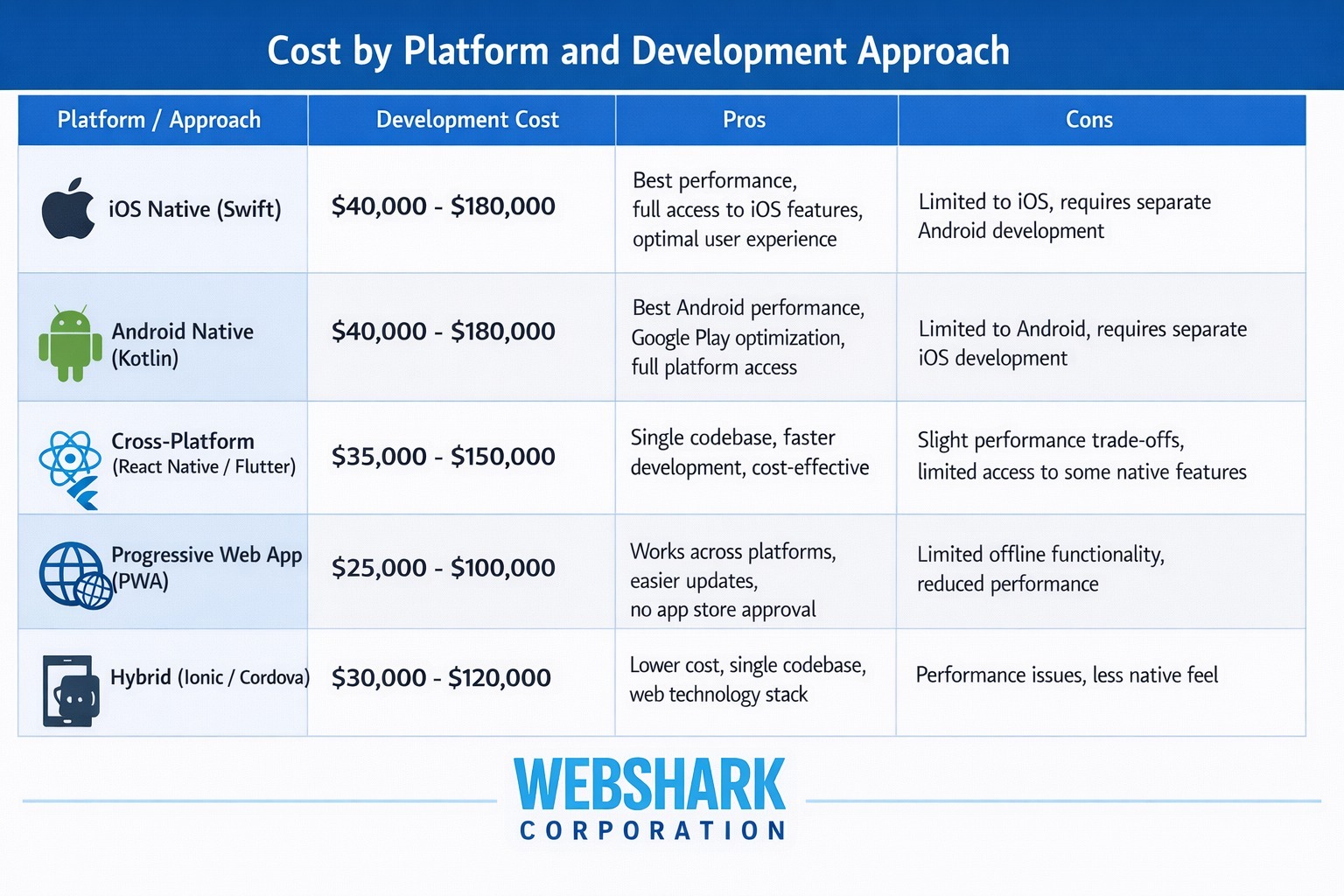
One of the most significant decisions affecting your budget is choosing between native development and cross-platform solutions. Native apps built specifically for iOS or Android deliver the best performance and user experience but require separate development teams and essentially double your initial investment.

Cross-platform frameworks like Flutter and React Native have matured significantly by 2026, offering near-native performance while maintaining a single codebase. This approach can reduce costs by 30-40% compared to building separate native applications.

Team Composition and Location

The geographical location of your development team dramatically impacts pricing. A mobile app development company in USA typically charges premium rates due to higher operational costs, but many clients find the value in timezone alignment, communication ease, and quality standards worth the investment.

Webshark Corporation and similar US-based firms offer distinct advantages including adherence to data protection regulations, intellectual property security, and established development processes that meet international standards.

Feature Complexity and Custom Functionality

Standard features like user registration, push notifications, and basic CRUD operations are well-understood and relatively affordable. However, innovative features requiring artificial intelligence, machine learning, augmented reality, or blockchain technology significantly increase development complexity and costs.

Real-time functionality, such as live streaming, instant messaging, or collaborative features, requires robust backend architecture and ongoing server costs. These features can add $15,000 to $50,000 or more to your project budget.

Design Sophistication

In 2026, users expect polished, intuitive interfaces that feel natural and responsive. Custom animations, micro-interactions, and motion design create memorable user experiences but require specialized designers and additional development time.

Apps with basic, template-based designs might save you $10,000 to $20,000 upfront, but they risk looking generic and failing to capture user attention in crowded app stores. Investing in distinctive design often correlates directly with higher user retention rates.

Security and Compliance Requirements

App Data security has become non-negotiable in 2026. Applications handling sensitive user information, payment data, or healthcare records must comply with regulations like GDPR, HIPAA, CCPA, and industry-specific standards.

Implementing enterprise-grade security features including end-to-end encryption, secure authentication protocols, penetration testing, and compliance audits can add $15,000 to $75,000 to your development costs depending on requirements.

Backend Infrastructure and Scalability

Your app’s backend architecture determines its ability to handle growth. A simple backend serving a few hundred users costs significantly less than a scalable system designed to support millions of concurrent users.

Cloud infrastructure costs vary based on usage. While development and testing might cost $100-500 monthly, a successful app with substantial user traffic could incur $2,000 to $20,000+ monthly in server costs. Planning for scalability from the start prevents expensive migrations later.

Third-Party Integrations

Modern apps rarely operate in isolation. Integration with payment processors, social media platforms, analytics tools, CRM systems, and marketing automation platforms extends functionality but adds complexity.

Each integration requires development time for API connection, error handling, data synchronization, and testing. Budget $2,000 to $15,000 per major integration depending on complexity and documentation quality.
app development cost

Pricing Models: Understanding Your Options

Fixed-Price Projects

The fixed-price model works well for projects with clearly defined scope and requirements. You receive a comprehensive quote covering all agreed-upon features, and the development team assumes the risk of any cost overruns.

This approach offers budget certainty but requires extensive upfront planning. Changes to project scope typically incur additional charges. Fixed-price works best for small to medium projects with stable requirements.

Time and Materials

The time and materials model charges based on actual hours worked at agreed hourly rates. This flexible approach accommodates evolving requirements and allows for iterative development based on user feedback and market validation.

While less predictable in total app development cost, this model often results in better products because it enables refinement throughout development. Most mobile app optimize companies in USA recommend this approach for complex projects where requirements may evolve.

Dedicated Team Model

For long-term projects or ongoing development needs, the dedicated team model provides a group of developers, designers, and project managers working exclusively on your project. You pay monthly rates for the team, typically at a discount compared to time and materials.

This model suits businesses planning continuous app evolution, requiring 6+ months of development, or needing guaranteed resource availability. Companies like Webshark Corporation often structure enterprise engagements this way.

Milestone-Based Payments

A hybrid approach combines fixed-price and time-and-materials benefits. Projects are divided into development milestones with payments tied to deliverable completion. This provides some budget predictability while maintaining flexibility within each phase.

Typical milestone structures include: 20-30% upon project kickoff, 30-40% at design completion, 20-30% at development completion, and 10-20% after testing and deployment.
app development cost

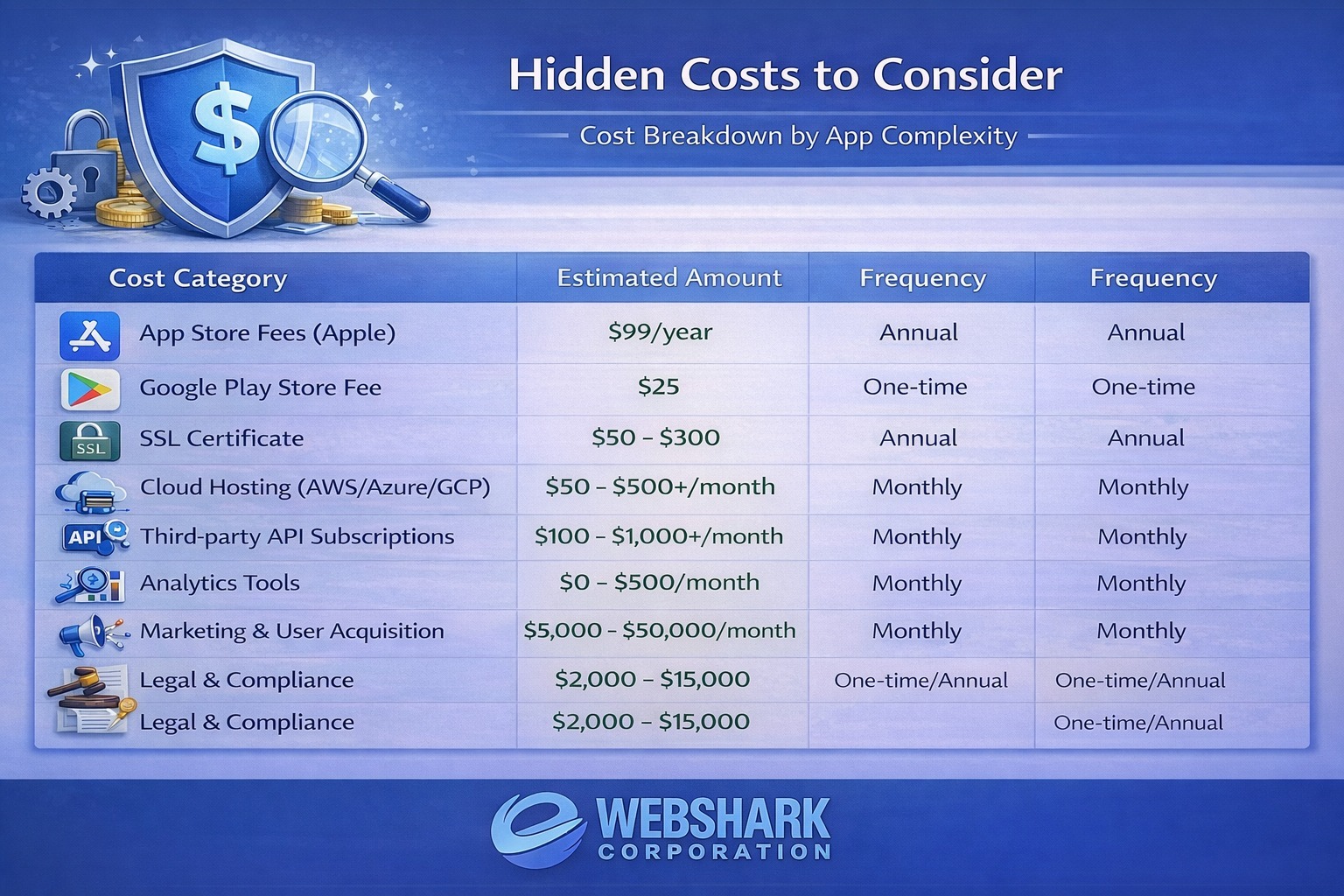
Hidden App Development Costs That Catch Businesses Off-Guard

App Store Optimization and Marketing

Building your app represents only half the battle. Without users, even the most brilliantly developed application fails. App store optimization (ASO), user acquisition campaigns, and marketing efforts often cost as much or more than initial development.

Budget $10,000 to $100,000+ for launch marketing depending on your target market size and competition level. Ongoing user acquisition costs vary dramatically by industry, with some categories like gaming or finance spending $5+ per acquired user.

Legal and Intellectual Property Protection

Protecting your intellectual property, drafting user agreements, creating privacy policies, and ensuring compliance with various regulations requires legal expertise. Initial legal setup typically app development costs $3,000 to $15,000, with ongoing legal review needed as regulations evolve.

If your app operates internationally, legal costs multiply as you navigate different jurisdictions and data protection laws. Enterprise applications often invest $25,000+ annually in legal compliance.

Documentation and Training

Comprehensive technical documentation ensures smooth handoffs and future maintenance. User documentation, admin guides, and API documentation typically add 5-10% app development costs but prove invaluable for team transitions and scaling.

If your app includes admin panels or internal tools, budget for training materials and sessions. Complex enterprise systems may require $5,000 to $20,000 for comprehensive training programs.

Localization and Internationalization

Expanding to international markets requires app localization beyond simple translation. Cultural adaptation of imagery, date formats, currency handling, and right-to-left language support adds complexity.

Professional localization costs $0.10 to $0.25 per word, with typical apps containing 5,000 to 50,000 words. Factor in $10,000 to $100,000 for comprehensive multi-language support including testing across all supported languages.

Emerging Technologies Impacting 2026 Pricing

Artificial Intelligence and Machine Learning

AI integration has moved from cutting-edge to expected in many app categories. Features like personalized recommendations, predictive text, image recognition, and chatbots enhance user experience but require specialized expertise.

Machine learning models need training data, computational resources, and ongoing refinement. Simple AI features start around $20,000, while sophisticated ML implementations can exceed $100,000. Companies like Webshark Corporation now maintain dedicated AI teams to meet growing demand.

Augmented and Virtual Reality

AR features have become more accessible through ARKit and ARCore, but creating compelling AR experiences still requires significant investment. Simple AR features like product visualization start around $25,000, while immersive AR experiences can cost $100,000+.

Virtual reality applications remain expensive, typically starting at $75,000 for basic experiences and exceeding $500,000 for complex VR solutions. As VR hardware becomes more mainstream, these costs are gradually decreasing.

Blockchain and Web3 Integration

Despite market volatility, blockchain technology continues evolving in app development. NFT marketplaces, cryptocurrency wallets, smart contract integration, and decentralized applications require specialized blockchain developers commanding premium rates.

Basic blockchain integration starts around $30,000, while comprehensive Web3 applications with custom smart contracts, token economics, and decentralized storage can cost $150,000 to $500,000+.

Internet of Things Connectivity

Apps connecting to IoT devices require hardware integration, real-time data processing, and often edge computing capabilities. Healthcare, home automation, and industrial applications increasingly demand IoT connectivity.

Development costs for IoT-connected apps typically start at $50,000 due to hardware testing requirements, protocol implementation, and complex state management across devices and cloud infrastructure.

App Cost Analyzer
Please enable JavaScript in your browser to complete this form.
Step 1 of 6
What type of mobile app are you planning?

Cost-Saving Strategies Without Compromising Quality

Minimum Viable Product Approach

The MVP strategy focuses on building core functionality first, validating market fit, then iterating based on real user feedback. This approach can reduce initial investment by 40-60% compared to building a feature-complete application.

Successful MVPs identify the smallest feature set that delivers value to early adopters. A mobile app development company in USA with MVP expertise can help identify which features are truly essential versus nice-to-have.

Phased Development Roadmap

Rather than building everything simultaneously, phased development spreads costs over time while generating revenue from earlier phases. Release Version 1.0 with core features, then add advanced functionality in subsequent updates.

This approach also reduces risk. If market response disappoints, you’ve invested less. If users love your app, their feedback guides feature prioritization for future phases.

Leveraging Existing Solutions

Don’t reinvent the wheel. Third-party SDKs and services for payment processing, authentication, analytics, and communication features cost far less than building custom solutions. While adding monthly operational costs, they dramatically reduce development time and upfront investment.

Open-source frameworks and libraries can also reduce costs, though require careful vetting for security, maintenance status, and licensing terms. Experienced developers know which solutions are production-ready.

Cross-Platform Development

As mentioned earlier, cross-platform frameworks like Flutter and React Native deliver substantial savings. While not suitable for every project, they work excellently for most business applications, e-commerce, content apps, and social platforms.

A skilled cross-platform developer can often deliver what would take two native development teams, reducing costs by 30-50% while maintaining 85-95% of native performance.

Selecting the Right Development Partner

Evaluating Potential Partners

When choosing a mobile app development company in USA or anywhere globally, look beyond hourly rates. Evaluate portfolios for projects similar to yours, read client testimonials, and verify technical expertise in your required technologies.

Webshark Corporation and reputable firms provide detailed case studies demonstrating problem-solving approaches, not just finished products. Ask about their development process, communication practices, and post-launch support options.

Red Flags to Watch For

Beware of quotes significantly below market rates—quality development cannot happen at bargain prices. Developers charging $20-30/hour in regions where market rates are $80-100/hour likely lack experience or will deliver subpar work.

Other warning signs include vague timelines, unwillingness to provide references, lack of a structured development process, and promises that seem too good to be true. If a vendor claims they can build your complex app in half the time others quote, they’re either underestimating or cutting corners.

Communication and Project Management

Effective project management directly impacts both cost and quality. Ensure your development partner has clear communication protocols, regular progress updates, and collaborative tools for feedback and approval.

Miscommunication and misaligned expectations cause most project failures. Invest time upfront clarifying requirements, defining success metrics, and establishing decision-making processes. This investment prevents expensive rework later.

Portfolio and Technical Expertise

Review potential partners’ technical capabilities thoroughly. Do they have experience with your required platform? Have they implemented similar features? Can they demonstrate apps currently in production with active users?

Request access to demo apps in app stores. A company claiming expertise in React Native, Flutter, Swift, or Kotlin should have published applications showcasing their skills.

Regional Pricing Differences Explained

North American Development

Working with a mobile app development company in USA or Canada offers numerous advantages despite higher costs. These include shared timezone and language, cultural alignment, strong intellectual property protections, and established business practices.

US-based firms typically charge $100-250+ per hour but deliver predictable quality, clear communication, and adherence to deadlines. For businesses where time-to-market and seamless collaboration are priorities, US development often proves cost-effective despite premium rates.

European Development Centers

Western Europe provides excellent quality at moderate pricing. Eastern European countries like Poland, Ukraine, and Romania have emerged as development powerhouses, offering skilled developers at 40-60% of US rates while maintaining high quality standards.

European developers generally have strong English proficiency, similar work cultures to North America, and convenient timezone overlap for East Coast US clients. Many US companies successfully partner with European teams for cost-effective development.

Asian Development Markets

India, the Philippines, and Vietnam offer the most affordable development rates globally. However, success requires selecting the right partners carefully. Top-tier Indian development firms deliver excellent quality at competitive prices, while budget providers may struggle with communication, quality control, and project management.

Asia’s timezone difference can be challenging for real-time collaboration but beneficial for around-the-clock development progress. Well-managed Asian projects can deliver 50-70% cost savings compared to US development while maintaining acceptable quality.

Latin American Nearshoring

Latin America has become increasingly popular for US businesses seeking cost savings with minimal timezone challenges. Countries like Argentina, Colombia, and Mexico provide talented developers at 50-70% of US rates with only 1-3 hour time differences.

Latin American developers often have strong cultural affinity with US clients, good English proficiency, and similar business practices, making collaboration smoother than Asian outsourcing while maintaining significant cost advantages over domestic development.

Future-Proofing Your Investment

Scalable Architecture

Building scalable architecture from the start prevents costly rebuilds as your user base grows. While more expensive initially—perhaps adding 20-30% to development costs—scalable systems save dramatically compared to re-architecting later.

Discuss load expectations with your development team. If you hope for viral growth or rapid scaling, invest in cloud-native architecture, microservices, and database solutions that scale horizontally.

Modular Development

Modular architecture allows replacing or upgrading individual components without affecting the entire application. This approach facilitates easier maintenance, faster feature additions, and simplified testing.

While requiring more upfront planning, modular development reduces long-term costs by making the codebase more maintainable and reducing regression risks when adding features or fixing bugs.

Documentation and Knowledge Transfer

Comprehensive technical documentation ensures your app isn’t hostage to a single developer or team. Invest in architectural documentation, API specifications, deployment procedures, and code commenting.

Knowledge transfer processes should be part of your contract. Whether continuing with the same team or transitioning to new developers, documentation dramatically reduces onboarding time and prevents knowledge loss.

Planning for Technology Evolution

Technology stacks evolve rapidly. Platforms introduce new features, deprecate old ones, and occasionally make breaking changes. Budget for annual technology updates to keep your app compatible, secure, and performant.

Most mobile app development companies in USA recommend allocating 15-25% of initial development costs annually for maintenance, updates, and incremental improvements. Apps receiving regular updates retain users better and maintain higher ratings.

Conclusion: Making Informed Decisions

Understanding app development pricing in 2026 empowers you to budget appropriately and select the right development approach for your business goals. Whether you’re building a simple MVP or a complex enterprise solution, transparency about costs helps prevent surprises and project failures.

Remember that the cheapest option rarely delivers the best value. Quality mobile application development requires experienced professionals, thoughtful planning, rigorous testing, and ongoing support. Companies like Webshark Corporation and other established mobile app development companies in USA provide the expertise and accountability that justify their premium positioning.

Your app represents a significant investment in your business’s future. Taking time to understand costs, evaluate options, and select the right partners increases your chances of building an application that delights users, achieves business objectives, and delivers strong return on investment.

The key to successful app development in 2026 isn’t just managing costs—it’s investing wisely in the right features, technologies, and partnerships that position your business for sustainable growth in an increasingly mobile-first world.

Summary