

Last updated: November 2026. Written by the Webshark Web Services team.
Quick answer: Off-the-shelf software is the right choice for UK businesses when a standard process (accounting, payroll, basic CRM) is well served by an existing product and speed matters most. Bespoke software is the better investment when your processes are a competitive advantage, you are paying for several tools that do not talk to each other, or licence fees grow with every user you add. Many UK firms use a hybrid: off-the-shelf for commodity functions and bespoke software to connect them and run the workflows that make the business different.
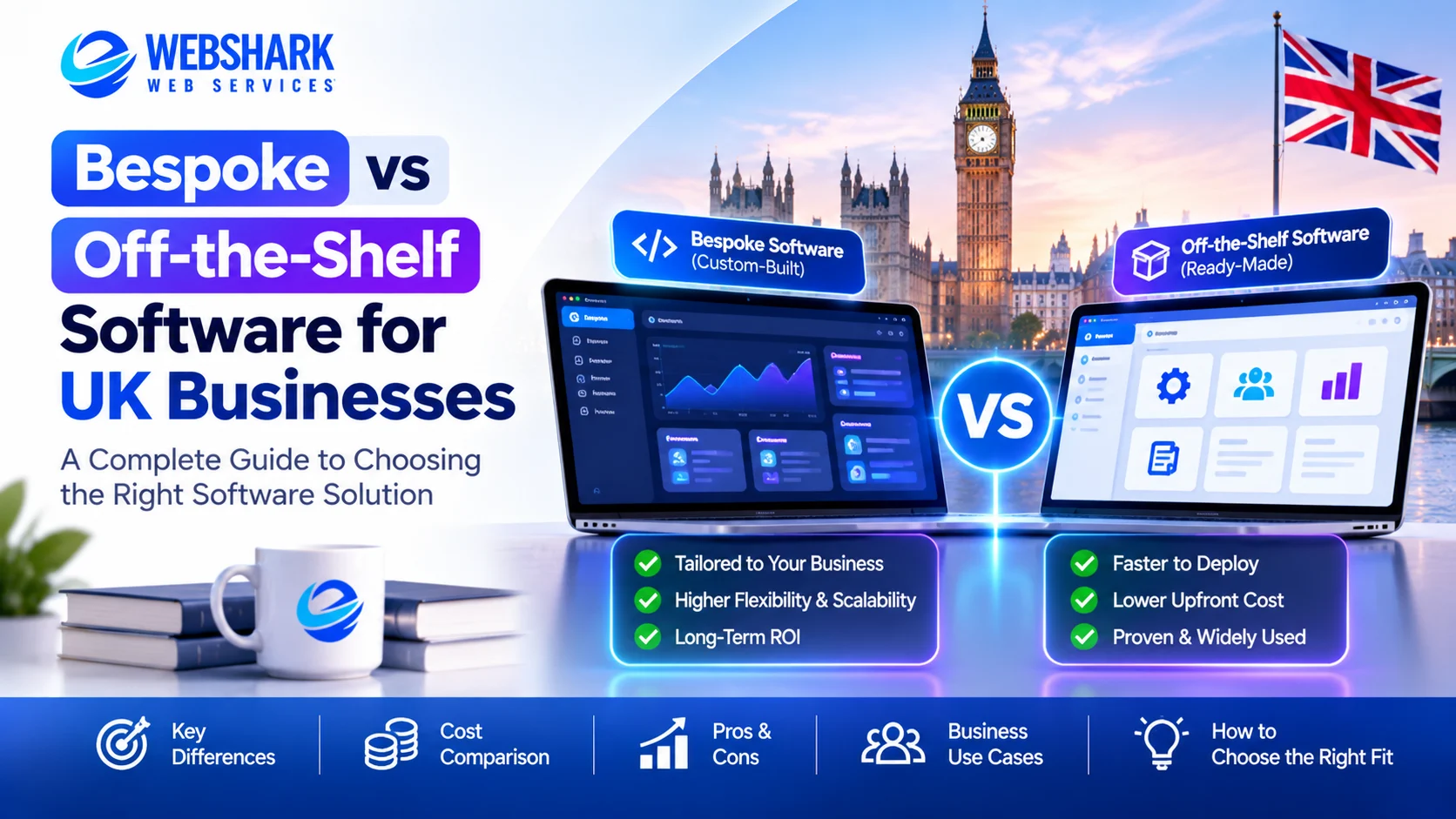
Choosing between bespoke and off-the-shelf software is one of the most important technology decisions a UK business makes. Get it right and software becomes an advantage. Get it wrong and you end up with expensive workarounds, spreadsheets and rising licence costs. This guide compares both options on cost, flexibility, compliance and long-term value so you can make the right call.
What is the difference between bespoke and off-the-shelf software?
Off-the-shelf software is a ready-made product sold to many businesses, usually as a monthly SaaS subscription. Examples include Xero, Sage, HubSpot and Microsoft 365.
Bespoke software (also called custom software) is designed and built specifically for your business, its workflows, users and systems. You typically own the code and decide how it evolves.
Bespoke vs off-the-shelf software: side-by-side comparison
| Factor | Off-the-shelf | Bespoke |
|---|---|---|
| Upfront cost | Low: setup and subscription | Higher: typically £25,000 to £250,000+ |
| Ongoing cost | Per-user licences that grow as you scale | Hosting and maintenance, usually 15% to 20% of build cost per year |
| Time to launch | Days to weeks | 2 to 9 months depending on scope |
| Fit to your processes | You adapt your processes to the software | Software is built around your processes |
| Integrations | Limited to available connectors | Built to connect with your existing systems |
| Scalability | Depends on the vendor’s plans and limits | Designed for your growth plans |
| Ownership and IP | Vendor owns the product | You own the software (check your contract) |
| Competitive advantage | Same tools as your competitors | Unique workflows competitors cannot copy easily |
| Vendor risk | Price rises, feature changes or product shutdown | Depends on code quality and documentation |
When off-the-shelf software makes sense
- The process is standard across industries, such as accounting, payroll or email.
- You need a solution live in days, not months.
- Your team is small and licence costs stay modest.
- The product covers at least 80% of your needs without heavy customisation.
When bespoke software is the better investment
- Your workflow is your advantage: for example, a unique quoting, scheduling or service delivery process.
- You are stitching tools together: staff copy data between systems or rely on spreadsheets to fill gaps.
- Licence costs are climbing: per-user pricing across several tools now exceeds the cost of building and owning a solution.
- You need specific integrations: legacy systems, industry platforms or partner APIs.
- Compliance needs control: you need full control over where data is stored and how it is processed.
The true cost over five years
Comparing first-year costs alone is misleading. Consider a 50-person UK business using three SaaS tools at an average of £45 per user per month. That is about £81,000 per year, or roughly £405,000 over five years, before price increases. A bespoke platform replacing those tools might cost £120,000 to build and £20,000 per year to host and maintain, about £220,000 over five years, while fitting the business exactly. The numbers will differ for every company, but a five-year total cost of ownership comparison often changes the decision.
UK-specific considerations
UK GDPR and data protection
Both options must comply with UK GDPR and the Data Protection Act 2018. With off-the-shelf tools, check where data is stored and what the vendor’s data processing agreement covers. With bespoke software, you can choose UK hosting and design privacy controls from the start.
R&D tax relief
Some bespoke software projects that resolve genuine technological uncertainty may qualify for UK R&D tax relief, which can reduce the effective cost of development. Eligibility rules are specific, so speak to your accountant or an R&D tax specialist early.
Making Tax Digital and sector rules
If your software touches finance, ensure compatibility with HMRC Making Tax Digital requirements. Regulated sectors such as financial services and healthcare may also need FCA or NHS-related standards to be considered in the design.
The hybrid approach: often the smartest option
You rarely need to choose one or the other for everything. Many UK businesses keep proven off-the-shelf tools for commodity tasks and invest in bespoke software for the core workflows that differentiate them, connected through APIs. This keeps costs under control while removing manual work and data silos.
How to decide: a simple checklist
- List the processes you want to improve and rank them by business impact.
- Check whether an existing product covers at least 80% of each need.
- Calculate five-year licence costs at your expected team size.
- Identify integration gaps and manual workarounds.
- Consider data protection, hosting and compliance requirements.
- If bespoke looks right, start with a discovery phase and an MVP to prove value quickly.
Getting started with bespoke software
Webshark designs and builds bespoke software for UK businesses, from internal tools and customer portals to complete SaaS platforms, with UK-friendly working hours and transparent fixed or agile pricing. Learn more about our bespoke software development services in the UK, see our app development services in the UK, or read why some companies replace multiple tools with one custom platform.
Frequently asked questions
How much does bespoke software cost in the UK?
Bespoke software in the UK typically costs £25,000 to £80,000 for a focused internal tool or MVP, £80,000 to £250,000 for a full business platform, and more for complex enterprise systems. Costs depend on features, integrations and the development team’s location.
Is bespoke software better than off-the-shelf?
Not always. Off-the-shelf is better for standard, low-complexity needs. Bespoke is better when processes are unique, integrations are essential or licence costs grow significantly with your team.
How long does it take to build bespoke software?
A focused MVP takes around 2 to 4 months. Larger platforms with multiple user types and integrations take 6 to 9 months or more, usually delivered in phases.
Who owns bespoke software?
In most bespoke development contracts the client owns the source code and intellectual property once paid for, but you should confirm this in writing before the project starts.