

The mobile app development landscape has evolved dramatically, and choosing the right framework can make or break your project’s success. Indeed, whether you’re a startup founder, an experienced developer, or just starting your coding journey, understanding the best mobile app development frameworks 2026 has to offer is crucial for building competitive applications.
Moreover, at Webshark Corporation, we’ve built hundreds of successful mobile applications using various frameworks, giving us unique insights into what works in real-world scenarios. Throughout this comprehensive guide, we’ll explore the top frameworks for mobile app development 2026, compare popular options like Flutter vs React Native, and help you choose the perfect tool for your next project.
Why Your Framework Choice Matters More Than Ever
The mobile app development trends 2026 show a clear shift toward efficiency, performance, and cross-platform compatibility. Notably, with over 6.8 billion smartphone users worldwide, businesses need apps that work seamlessly across Android and iOS without burning through development budgets.
Consequently, the right mobile app development framework can provide significant advantages. First and foremost, it can reduce development time by up to 50%. Additionally, it lowers costs through code reusability. Moreover, it improves app performance and user experience. Furthermore, it simplifies maintenance and updates. Finally, it helps future-proof your application.
Expert Insight: Making the wrong framework choice can cost you months of development time and thousands of dollars in rework. Therefore, if you’re new to mobile development or need expert guidance, consulting with experienced developers or agencies can save significant time and resources upfront.
Understanding Cross-Platform vs Native App Development
Before diving into specific frameworks, let’s clarify a fundamental decision every developer faces: cross-platform vs native app development.
Native Development means building separate apps for iOS (Swift/Objective-C) and Android (Kotlin/Java). While this approach offers maximum performance, it requires maintaining two codebases.
On the other hand, Cross-Platform Development uses frameworks that compile to native code or run on a JavaScript bridge, allowing you to write once and deploy everywhere. Furthermore, the best cross-platform mobile app frameworks 2026 have nearly closed the performance gap with native apps.
For most projects, especially startups and businesses with limited resources, cross-platform mobile app development frameworks offer the best balance of speed, cost, and quality.
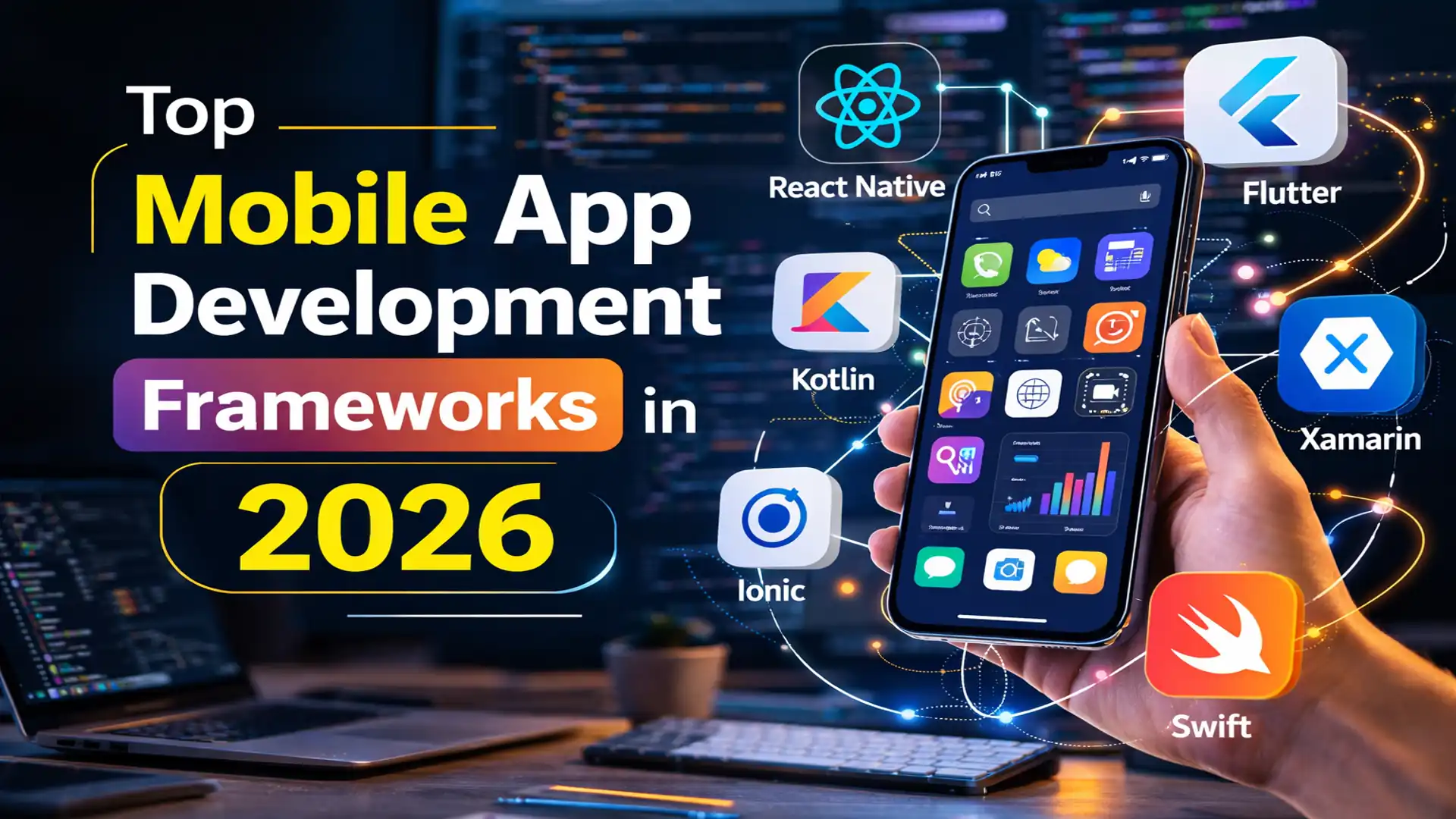
Top Mobile App Development Frameworks in 2026
1. Flutter: The Developer’s First Choice
Flutter remains the fastest mobile app development framework in 2026, backed by Google’s continuous investment and a thriving community of over 5 million developers worldwide.
Why Flutter Dominates the Market
Flutter stands out for several compelling reasons. To begin with, its Hot Reload feature allows you to see changes instantly without recompiling. In addition, it delivers Native Performance by compiling directly to ARM machine code. What’s more, it offers a Beautiful UI with pre-built Material Design and Cupertino widgets. Beyond that, it provides a Single Codebase that deploys to iOS, Android, web, and desktop. Last but not least, it boasts a Rich Ecosystem with over 35,000 packages on pub.dev.
Best For: Startups, MVP development, apps requiring custom UI, and teams prioritizing development speed
2026 Updates: Notably, Flutter 4.0 introduced improved web performance, enhanced desktop support, and better integration with platform-specific features.
2. React Native: The JavaScript Powerhouse
React Native continues to dominate as a top choice for web developers transitioning to mobile. Maintained by Meta, it powers apps like Facebook, Instagram, and Discord. Additionally, our team at Webshark Corporation has extensively covered why React Native is the future of mobile app development, and it remains one of our most recommended frameworks.
Core Strengths of React Native
React Native excels in multiple areas. Primarily, it allows developers to Leverage Web Skills by using JavaScript and React knowledge. Equally important, it has the Massive Community – the largest mobile development community available. In parallel, it offers Hot Reloading for fast development iteration. Simultaneously, it supports Native Modules for easy integration with platform-specific code. On top of that, the Expo Framework provides a simplified development workflow.
Best For: Teams with React experience, apps requiring extensive third-party integrations, and projects needing rapid prototyping
Real-World Example: For instance, the Mobile Passport Control App demonstrates React Native’s capability to handle complex, security-critical applications with millions of users.
2026 Updates: The new architecture (Fabric and TurboModules) is now production-ready, delivering near-native performance. Moreover, for businesses looking to leverage this technology, partnering with a React Native mobile app development company in USA can accelerate your project timeline significantly.
3. .NET MAUI: Microsoft’s Unified Platform
.NET Multi-platform App UI (MAUI) is Microsoft’s evolution of Xamarin, offering enterprise-grade mobile app development tools for startups and large organizations.
Key Features
.NET MAUI stands out with several enterprise-grade capabilities. First, it offers a Single Project approach with one codebase for iOS, Android, Windows, and macOS. Second, it provides C# Power with strong typing, LINQ, and async/await. Third, Blazor Integration allows you to share code between mobile and web. Fourth, you get Enterprise Support backed by Microsoft’s ecosystem. Fifth, Hot Reload enables real-time UI updates.
Best For: Enterprise applications, teams with .NET expertise, and apps requiring Windows integration
4. Kotlin Multiplatform Mobile (KMM)
Kotlin Multiplatform Mobile has matured significantly, offering a unique approach to cross-platform frameworks for mobile apps 2026.
What Makes It Unique
KMM offers a distinctive approach compared to traditional cross-platform frameworks. Most importantly, Gradual Adoption lets you share business logic while keeping native UI. Subsequently, Native Performance means no JavaScript bridge overhead. Concurrently, Type Safety comes from Kotlin’s robust type system. Specifically, Android-First design ensures seamless Android development. Lastly, iOS Interoperability works smoothly with Swift/Objective-C.
Best For: Android-heavy teams expanding to iOS, apps requiring maximum performance, and gradual migration from native
5. Ionic: The Web Technology Champion
Ionic leverages web technologies (HTML, CSS, JavaScript/TypeScript) to create hybrid mobile applications.
Web-Based Advantages
Ionic remains relevant due to several web-centric benefits. Initially, it leverages Web Skills, allowing you to use existing web development knowledge. Next, it’s Framework Agnostic, working seamlessly with React, Vue, or Angular. Then, Capacitor serves as a modern native bridge replacement for Cordova. Additionally, PWA Support enables deployment as progressive web apps. Ultimately, it’s Free and Open Source with zero licensing costs.
Best For: Web developers, PWAs, and projects requiring extensive web integration
Rating: ⭐⭐⭐⭐ (4/5) – Easiest mobile app framework for beginners with web experience
6. SwiftUI (Native iOS)
While not cross-platform, SwiftUI deserves mention as Apple’s declarative framework for iOS development.
Apple’s Modern Approach
SwiftUI offers compelling advantages for Apple platforms. Primarily, it features Modern Syntax with clean, declarative code. Alongside this, Live Preview provides real-time UI updates. In essence, Apple Ecosystem integration works deeply with iOS, macOS, and watchOS. Inherently, Performance comes from true native execution. Ultimately, it’s Future-Proof as Apple’s recommended approach.
Best For: iOS-exclusive apps, Apple platform developers
7. NativeScript
NativeScript offers another JavaScript-based approach to native mobile development.
Direct Native Access
NativeScript provides unique JavaScript-based native development capabilities. Chiefly, it offers Direct Native Access to call Android and iOS APIs directly. Similarly, Framework Choice allows you to use Angular, Vue, or vanilla JavaScript. Essentially, it delivers True Native UI without web views or bridges. Correspondingly, its Plugin Ecosystem grants access to native libraries.
Best For: JavaScript developers needing native API access
Flutter vs React Native 2026: The Ultimate Comparison
The flutter vs react native 2026 comparison is the most common dilemma developers face. Here’s an honest breakdown:
Performance
Winner: Flutter Flutter’s compilation to native ARM code gives it a slight edge. Meanwhile, React Native’s new architecture has closed the gap, but Flutter still leads in graphics-intensive applications.
Learning Curve
Winner: React Native JavaScript developers can start immediately. However, Flutter requires learning Dart, though it’s similar to JavaScript and TypeScript.
Community & Packages
Winner: React Native React Native has a larger community and more third-party libraries. Nevertheless, Flutter’s ecosystem is rapidly growing but still smaller.
Development Speed
Winner: Flutter Hot reload is faster, and widget-based architecture allows quicker UI development.
Job Market
Winner: React Native More React Native jobs are currently available, though Flutter positions are growing and often pay higher.
UI Customization
Winner: Flutter Flutter offers superior control over pixel-perfect designs. In contrast, React Native relies more on native components.
Verdict: Choose Flutter for performance-critical apps, custom UI, and greenfield projects. Alternatively, choose React Native if you have React expertise, need extensive third-party integrations, or want maximum community support.
Best Framework for Android and iOS App Development: Decision Matrix
Choosing the best framework for android and ios app development depends on several factors:
For Startups
Recommended: Flutter or React Native
Startups benefit from these frameworks in several ways. Primarily, they enable fast development cycles. Secondly, a single codebase means lower costs. Thirdly, developers are easy to find. Finally, you can deliver a quick MVP to market.
Tools: Flutter with Firebase or React Native with Expo
Startup Success Tip: At Webshark Corporation, we’ve helped numerous startups launch their MVPs in under 12 weeks using cross-platform frameworks. Importantly, the key is choosing a framework that matches your team’s existing skills while providing room for growth. Rather than over-engineering your first version, instead, focus on core features and iterate based on user feedback.
For Enterprises
Recommended: .NET MAUI or Flutter
Enterprise applications require specific characteristics. Fundamentally, they need robust architecture. Additionally, strong typing and testing are essential. Moreover, enterprise support is crucial. Lastly, scalability cannot be compromised.
For Beginners
Recommended: React Native or Ionic
The easiest mobile app framework for beginners depends on your background. Specifically:
- Web developers: Ionic or React Native work best
- No coding experience: Flutter is ideal (Dart is beginner-friendly)
- Python developers: Kivy or BeeWare are options (see Python section below)
For Maximum Performance
Recommended: Flutter or KMM Both compile to native code without JavaScript bridges.
Best Framework for Mobile App Development in Python
Python developers often ask about the best framework for mobile app development in python. While Python isn’t traditionally used for mobile, several options exist:
Popular Python Mobile Frameworks
Several Python frameworks exist for mobile development:
1. Kivy
Kivy offers cross-platform Python development with OpenGL-based graphics. Specifically, it works for Android, iOS, Windows, macOS, and Linux. Particularly, it’s best suited for games and multimedia apps.
2. BeeWare
BeeWare creates native Python mobile apps using platform-native UI elements. Essentially, you write once in Python and deploy everywhere. However, it has a growing but smaller community.
3. PyQt/PySide (Qt for Python)
PyQt provides both desktop and mobile support. Notably, it’s a mature framework that’s good for complex applications.
The Python Reality for Mobile
Reality Check: For production mobile apps, Python frameworks lag behind JavaScript and Dart options. Therefore, consider using Python for backend APIs with Flutter/React Native for the frontend.
How to Choose Mobile App Framework: Step-by-Step Guide
Follow this process to select the best mobile development stack 2026:
Step 1: Define Your Requirements
First, identify your core needs. Specifically, determine your target platforms (iOS, Android, web, desktop?). Likewise, assess your performance needs (graphics-intensive vs. CRUD). Additionally, establish your timeline and budget. Finally, evaluate your team expertise.
Step 2: Evaluate Team Skills
Next, match frameworks to your team’s strengths. Particularly, JavaScript experts should consider React Native. Meanwhile, web developers work well with Ionic or React Native. Similarly, C# developers excel with .NET MAUI. In contrast, Android developers benefit from Kotlin Multiplatform. On the other hand, those with a fresh start should explore Flutter.
Step 3: Consider Long-Term Maintenance
Additionally, think about sustainability. Primarily, evaluate community size and activity. Furthermore, consider corporate backing from companies like Google, Meta, or Microsoft. Moreover, assess the package ecosystem available. Lastly, check the update frequency and roadmap.
Step 4: Prototype and Test
Build a simple proof-of-concept with your top 2-3 choices. Subsequently, test several key factors. Initially, measure development speed. Then, evaluate performance on target devices. Afterward, assess ease of platform-specific features. Finally, gauge team comfort level with each framework.
Step 5: Check Business Factors
Finally, evaluate practical considerations. Primarily, review licensing costs (all major frameworks are free, but consider support). Next, assess hiring availability in your region. Additionally, verify third-party service integrations. Lastly, ensure scalability for future growth.
Partner with Experts: If you’re unsure about the technical implementation, consider working with experienced mobile app development agencies who can guide you through the selection process. Furthermore, for businesses in specific regions, researching top mobile app development companies in Dallas or other tech hubs can help you find local expertise. Additionally, you can explore comprehensive lists of app development companies in USA to find the right partner for your project.
Best Tools for Mobile App Development
Beyond frameworks, here are essential mobile app development tools for startups and established teams:
Development Environments
First, you’ll need a solid IDE. Generally speaking, you have three main options:
- Visual Studio Code: Free, extensible, works with all frameworks
- Android Studio: Official Android IDE, excellent for Flutter and native development
- Xcode: Required specifically for iOS development and testing
Design and Prototyping
Next, consider these design tools for your workflow:
- Figma: Collaborative design that converts to Flutter code
- Adobe XD: Comprehensive UI/UX design with developer handoff
- Sketch: Mac-only design tool favored by many designers
Backend and APIs
Furthermore, choose your backend infrastructure wisely:
- Firebase: Authentication, database, and hosting with a generous free tier available
- Supabase: Open-source Firebase alternative gaining popularity
- AWS Amplify: Enterprise-grade scalable backend services
Testing
Additionally, implement robust testing solutions:
- Flutter DevTools: Built-in debugging and profiling capabilities
- React Native Debugger: Chrome-based debugging environment
- BrowserStack: Real device testing across multiple platforms
CI/CD
Finally, automate your deployment pipeline:
- GitHub Actions: Automated testing and deployment workflow
- Bitrise: Mobile-specific CI/CD platform
- Codemagic: Built specifically for Flutter, also works with others
Top Mobile App Development Frameworks in 2026 Free Options
Importantly, all the modern mobile app development frameworks list mentioned in this article are free and open source. Specifically:
- Flutter – Apache 2.0 License
- React Native – MIT License
- .NET MAUI – MIT License
- Ionic – MIT License
- Kotlin Multiplatform – Apache 2.0 License
- NativeScript – Apache 2.0 License
Consequently, this makes the top mobile app development frameworks in 2026 free for commercial use, with no licensing fees regardless of company size or revenue.
Mobile Application Development Framework and Tools: The Complete Stack
A production-ready mobile application development framework requires more than just the core framework. In fact, you’ll need a complete ecosystem:
Essential Stack Components:
At the foundation, you need the Framework itself (Flutter, React Native, etc.). Following that, implement State Management solutions like Redux, Provider, BLoC, or MobX. Alongside this, set up your Backend with REST API or GraphQL server. Similarly, configure your Database – either Cloud-based (Firebase, Supabase) or local (SQLite, Realm).
In addition, integrate Authentication using OAuth, JWT, or biometric methods. Furthermore, add Analytics through Google Analytics, Mixpanel, or Amplitude. Equally important, implement Crash Reporting with Sentry or Firebase Crashlytics. Next, enable Push Notifications via Firebase Cloud Messaging or OneSignal. Moreover, set up Payment Integration with Stripe, PayPal, Apple Pay, or Google Pay. Finally, establish Version Control using Git with GitHub, GitLab, or Bitbucket.
Latest Mobile App Development Frameworks: 2026 Innovations
The latest mobile app development frameworks and updates include:
Emerging Technologies
The technology landscape continues to evolve rapidly. Primarily, AI Integration stands out as all major frameworks now have AI/ML libraries. Notably, the rise of AI-powered mobile apps is transforming how users interact with applications, from personalized recommendations to predictive analytics. Simultaneously, AR/VR Support has expanded as Flutter and React Native added enhanced AR capabilities. Correspondingly, Wearable Support has improved with better smartwatch and fitness tracker integration. Lastly, Foldable Devices now have native support for foldable and dual-screen devices.
Real-World Success Stories: For example, apps like the Signal app, built with modern frameworks, showcase how privacy-focused development can scale to millions of users. Similarly, specialized applications like the Trackwrestling mobile app demonstrate how frameworks can handle niche sports technology with complex real-time features.
Framework Updates
Major frameworks have released significant updates in 2026. Specifically, Flutter 4.x delivered improved web and desktop parity. Meanwhile, React Native New Architecture introduced the production-ready Fabric renderer. In parallel, .NET MAUI Blazor Hybrid enabled seamless web-to-mobile code sharing. Additionally, Compose Multiplatform brought Jetpack Compose to iOS (from JetBrains).
Top Mobile App Development Frameworks in 2026 for Android
While all cross-platform frameworks support Android, Android-first options include several strong contenders. Primarily, Flutter offers excellent Material Design support. Subsequently, Kotlin Multiplatform provides native Kotlin with iOS expansion capabilities. Alternatively, Jetpack Compose serves as the native Android UI framework. Finally, React Native brings mature Android support to the table.
Notably, for pure Android development, Jetpack Compose with Kotlin is the modern standard. However, cross-platform mobile app frameworks offer better business value for most projects.
Ready to Build Your Mobile App?
Choosing the right framework is just the first step. At Webshark Corporation, we transform your app ideas into reality using the most suitable frameworks for your specific needs.
Who We Serve
Whether you’re a startup launching your first MVP or an enterprise scaling your mobile presence, our experienced team delivers production-ready applications on time and within budget.
Our Comprehensive Services
We offer a full range of mobile development services. Initially, we provide framework consultation and technology stack selection. Subsequently, we handle custom mobile app development for iOS, Android, and cross-platform solutions. Moreover, we specialize in legacy app modernization and migration. Additionally, we deliver UI/UX design and prototyping. Furthermore, we ensure quality assurance and testing. Finally, we provide post-launch support and maintenance.
Contact Webshark Corporation today to discuss your mobile app project and get a free consultation.
Mobile App Development Technologies: Future Trends
Looking ahead, these mobile app development technologies are gaining traction:
1. Edge Computing
Increasingly, mobile apps are processing data closer to users for lower latency.
2. 5G Optimization
Meanwhile, frameworks are adapting to leverage 5G’s speed and low latency.
3. Privacy-First Development
Furthermore, enhanced privacy features are being built into frameworks by default.
4. No-Code Integration
Additionally, visual development tools are complementing traditional frameworks.
5. Sustainability
Finally, frameworks are optimizing for battery efficiency and reduced resource usage.
Conclusion: Making Your Framework Decision
The best mobile app development frameworks 2026 offer incredible power and flexibility. Here’s the quick decision guide:
Choose Flutter if:
Flutter is your best choice under certain conditions. Primarily, you should choose it when you want the fastest development speed. Additionally, it’s ideal if you need custom, pixel-perfect UI. Furthermore, it excels when you’re building a startup MVP. Lastly, select Flutter when performance is critical for your application.
Choose React Native if:
React Native becomes the right choice in specific scenarios. Particularly, it’s perfect when your team knows JavaScript/React. Moreover, it’s ideal when you need maximum community support. Similarly, choose it when you want the largest package ecosystem. Lastly, it excels when you’re integrating with many third-party services.
Choose .NET MAUI if:
.NET MAUI suits specific enterprise needs. Primarily, it’s best when you’re building enterprise applications. Additionally, select it when your team uses C# and .NET. Furthermore, it’s ideal when you need Windows desktop support. Finally, choose it when you want Microsoft’s enterprise backing.
Choose Kotlin Multiplatform if:
Kotlin Multiplatform fits certain technical profiles. Specifically, it’s perfect when you’re Android-first with iOS expansion plans. Moreover, choose it when you want maximum performance. Additionally, it’s ideal when you prefer native UI on each platform. Finally, select it when you have strong Android expertise.
Choose Ionic if:
Ionic serves web-focused developers well. Primarily, it’s best when you’re primarily a web developer. Additionally, choose it when you need PWA capabilities. Furthermore, it’s ideal when you want framework flexibility (React/Vue/Angular). Lastly, select it when budget is extremely tight.
Remember, there’s no universally “best” framework—only the best framework for your specific project, team, and goals. Ultimately, the mobile application development framework you choose should align with your technical requirements, team skills, timeline, and long-term maintenance plans.
To get started, begin with a proof-of-concept, involve your team in the decision, and choose the framework that feels right. Importantly, all the options listed here are production-ready and power millions of successful apps.
Need More Guidance? Explore additional resources on the Webshark Corporation blog for in-depth tutorials, case studies, and framework-specific guides.
Ready to build? Pick your framework and start coding. Indeed, the mobile app world is waiting for your ideas.
About Webshark Corporation: Webshark Corporation is a leading mobile app development company specializing in cross-platform and native mobile solutions. Our team of expert developers has hands-on experience with all major frameworks mentioned in this guide, having delivered successful applications across healthcare, fintech, e-commerce, and enterprise sectors. This guide draws on our real-world experience building mobile applications, staying current with the latest framework updates, and helping development teams make informed technology decisions.