
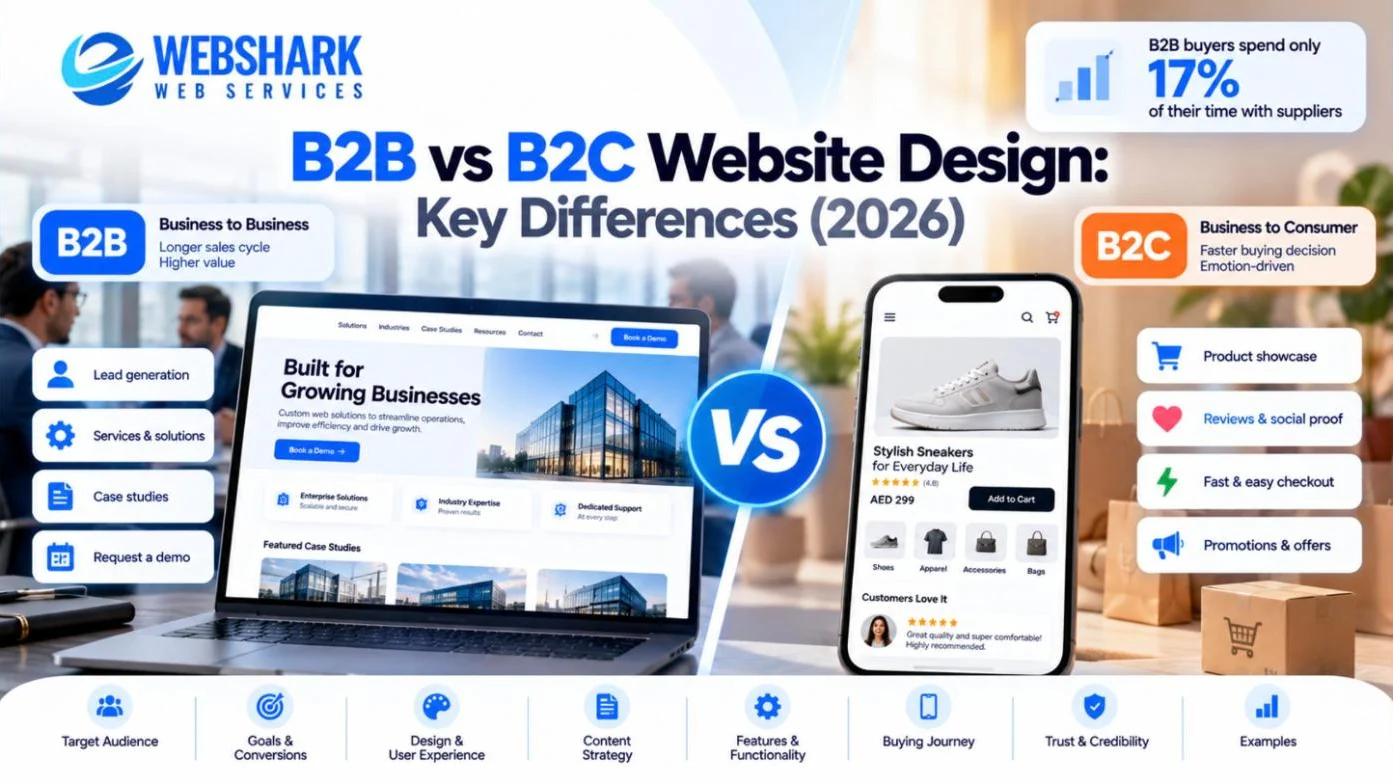

A website that sells software to procurement teams and a website that sells sneakers to shoppers both need to be fast, clear and trustworthy. But the way people buy is completely different, so the design strategy has to be different too.
B2B buyers do most of their research on their own. Gartner research, as cited by Consensus, found that B2B buyers spend only about 17% of their buying time meeting with potential suppliers. B2C shoppers, on the other hand, often decide in minutes on a phone. This guide explains how B2B and B2C website design differ in 2026 and how to get each right.
How B2B and B2C Buyers Differ
- Decision makers: B2B purchases usually involve several stakeholders such as users, managers, finance and IT. B2C purchases are usually made by one person.
- Sales cycle: B2B can take weeks or months. B2C can take minutes.
- Motivation: B2B buyers focus on ROI, risk, integration and support. B2C buyers respond to price, convenience, emotion and brand.
- Order value: B2B deals are usually larger and often recurring. B2C orders are smaller but more frequent.
B2B Website Design: What Matters Most
Clear value proposition by role and industry
B2B visitors want to know quickly whether you solve their problem. Use dedicated pages for industries, use cases and roles, and lead with outcomes rather than features.
Depth of content and proof
Because buyers research independently, your website does much of the selling. Detailed case studies, whitepapers, comparison pages, documentation, pricing guidance and FAQs help buyers build an internal business case. Real client results and named examples carry more weight than generic claims.
Trust and risk reduction
Security certifications, compliance information, client logos, reviews on independent platforms and clear contact details reduce perceived risk for enterprise buyers.
Lead capture that respects the buyer
Offer several paths: book a demo, request a proposal, talk to sales or download a guide. Keep forms short, and use chat or AI assistants to answer questions instantly and qualify leads.
Integration with sales systems
B2B websites work best when connected to a CRM, marketing automation and analytics, so sales teams can see which pages and content a lead engaged with. Our custom CRM development team often builds these connections.
B2C Website Design: What Matters Most
Speed and mobile-first experience
B2C shoppers browse mostly on phones and leave quickly if pages are slow. A Deloitte study published on web.dev found that a 0.1-second improvement in mobile site speed increased retail conversion rates by 8.4%.
Visual, emotional storytelling
High-quality product imagery, short videos, lifestyle content and a strong brand voice help shoppers imagine owning the product.
Frictionless checkout
Guest checkout, saved details, wallet payments like Apple Pay, Google Pay and UPI, clear delivery dates and easy returns all reduce cart abandonment.
Social proof and personalization
Ratings, reviews, user photos and personalized recommendations build confidence and increase order value.
What B2B and B2C Websites Have in Common in 2026
- Fast loading and strong Core Web Vitals
- Accessible design that meets WCAG 2.2 standards
- Clear navigation and obvious calls to action
- Structured data so search engines and AI assistants understand your pages
- Analytics that track real business outcomes, not just traffic
B2B vs B2C Website Design Checklist
- B2B: industry and role pages, case studies, pricing guidance, security and compliance details, demo and proposal forms, CRM integration.
- B2C: mobile-first product pages, strong visuals, reviews, fast checkout, wallet payments, personalized recommendations.
For broader design guidance, see our article on web design trends and UX best practices for 2026, and our guide on website redesign vs UX conversion strategy.
Final Thoughts
B2B websites win by answering every question a buying committee might ask and making it easy to start a conversation. B2C websites win by being fast, visual and effortless to buy from. Designing for how your customers actually buy is the single biggest factor in turning traffic into revenue.
Webshark designs and builds B2B and B2C websites for clients in India, the US and the Middle East, including a B2B distributor portal for Bison Life and a luxury B2C store for Devji Since 1950. Explore our UI/UX design and development services or contact our team.