


Imagine you've just launched your dream app. Thousands of users sign up on Day 1. Then — crash. A critical bug breaks the checkout flow, users lose trust, and your reviews tank overnight.
This isn't a hypothetical. It happened to major companies like Boeing, Knight Capital Group, and even Amazon — all because of Software bugs that slipped past the gate. Knight Capital alone lost $440 million in 45 minutes due to a faulty deployment with no proper testing strategy in place.
That's the brutal reality of shipping software without a solid testing plan.
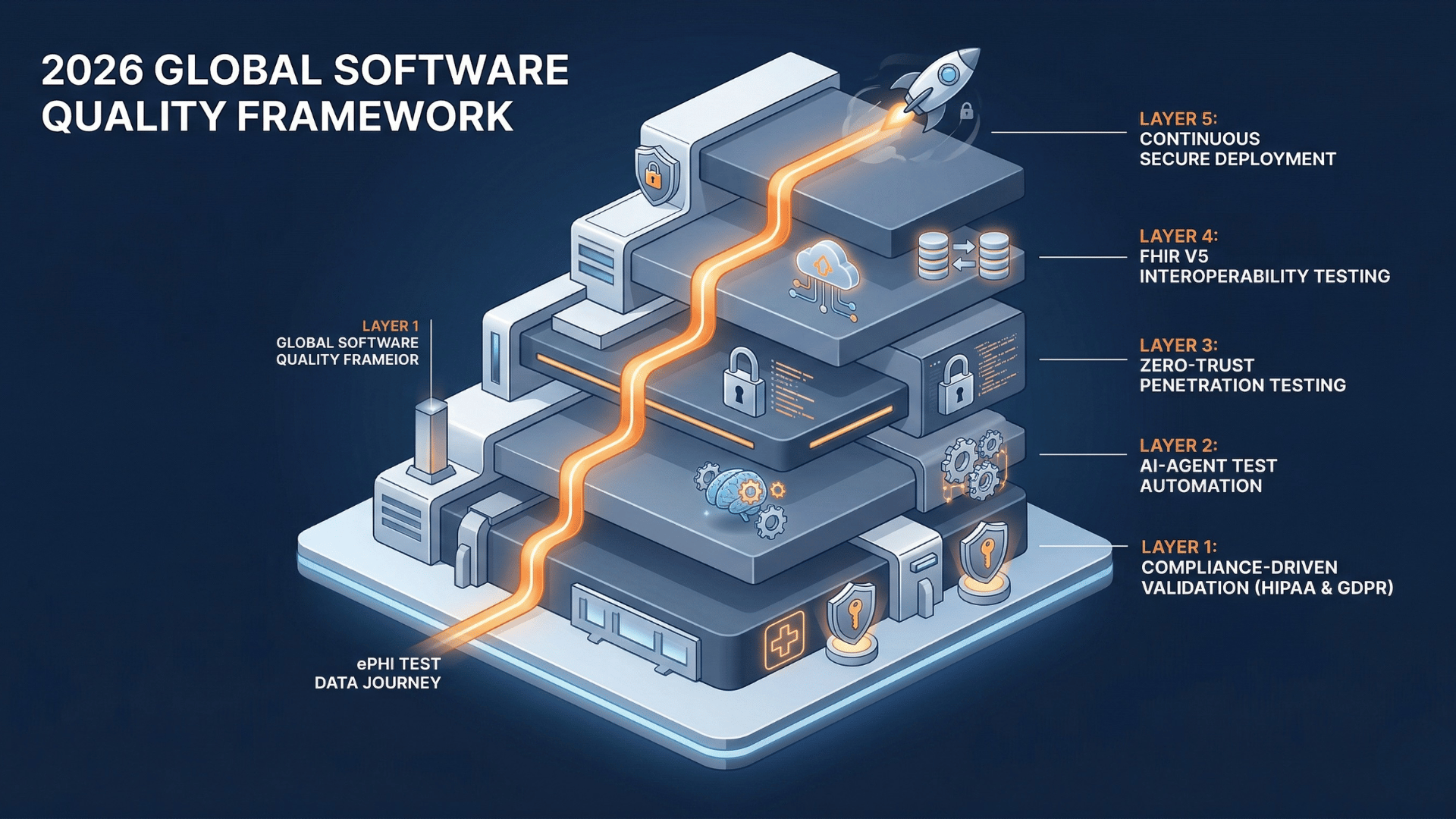
Whether you're a developer, QA engineer, product manager, or a startup founder, understanding software testing strategies is non-negotiable in 2026. This guide — brought to you by Webshark Corporation, a trusted name in digital innovation — breaks down everything you need to know — clearly, practically, and without the jargon overload.
What Is a Software Testing Strategy?
A software testing strategy is a high-level plan that defines how software will be tested throughout the development lifecycle. It outlines the testing objectives, methods, environments, tools, and responsibilities involved in validating a software product.
Think of it as your team's "game plan" before the big match. Without it, everyone's just kicking in different directions.
A good testing strategy answers key questions like:
- What needs to be tested?
- When will testing happen?
- Who will do the testing?
- What tools and techniques will be used?
- How will defects be tracked and resolved?
It sits above the test plan (which is more detailed and project-specific) and guides decisions across the entire QA process.
Why Software Testing Strategies Matter
Here's a stat that should wake up any dev team:
According to a report by the Consortium for IT Software Quality (CISQ), poor software quality cost U.S. companies $2.41 trillion in 2022 alone.
That number is staggering. And most of it traces back to inadequate testing. A well-defined testing strategy helps teams:
- Catch bugs early — fixing a bug in development costs 10x less than fixing it after release
- Reduce rework — fewer last-minute fires mean faster delivery
- Build user trust — consistent quality leads to loyal customers
- Meet compliance requirements — critical in industries like healthcare and finance
- Enable faster releases — especially when paired with CI/CD pipelines
In short: testing isn't just about finding bugs. It's about building confidence in your product. Every serious software development company in USA treats testing as a core part of their delivery process — not an afterthought.
Types of Software Testing Strategies
There's no one-size-fits-all approach. Different projects call for different strategies. Here are the main ones you need to know:
Manual Testing Strategy
A human tester manually executes test cases without automation tools. It's exploratory, intuitive, and great for catching UI/UX issues machines might miss.
Real-world example: A QA tester navigating an e-commerce site the way a real customer would — clicking buttons, trying edge cases, and reporting anything that feels off.
✓ Pros
- Flexible and adaptable
- Good for complex user flows
- No setup cost
✗ Cons
- Time-consuming at scale
- Prone to human error
- Not repeatable efficiently
Automated Testing Strategy
Test scripts are written and executed automatically using tools like Selenium, Cypress, JUnit, or TestNG. This is the backbone of modern CI/CD pipelines.
Real-world example: Netflix runs thousands of automated tests on every code commit to ensure their streaming service never goes down — even during deployments.
✓ Pros
- Fast and scalable
- Highly repeatable
- Frees up QA teams
✗ Cons
- High setup cost
- Requires ongoing maintenance
- Not ideal for UX testing alone
Black Box Testing Strategy
Testers evaluate the software's functionality without knowing its internal code or architecture. They only see inputs and outputs.
Techniques: Equivalence partitioning · Boundary value analysis · Decision table testing
Example: Testing a login form by trying valid credentials, wrong passwords, special characters, and blank fields — without caring how the backend authentication works.
White Box Testing Strategy
Also called glass box or clear box testing. Testers have full visibility into the source code and design the tests based on internal logic, paths, and conditions.
Techniques: Statement coverage · Branch/path coverage · Loop testing
Example: A developer writing unit tests to check that each function in a payment module handles all edge cases — divide by zero, null inputs, overflow values.
Grey Box Testing Strategy
A hybrid of black box and white box. Testers have partial knowledge of the internal workings — enough to write smarter tests, but they still test from the user's perspective.
Regression Testing Strategy
Every time new code is added, old features can break. Regression testing ensures that new changes don't introduce bugs into previously working functionality.
Studies show that 80% of bugs come from 20% of the code modules. Regression testing targets those high-risk zones.
Tools: Selenium · Appium · TestComplete · Ranorex
Best practice: Automate your regression suite. Running it manually every sprint is a fast track to burnout.
Risk-Based Testing Strategy
Not everything can be tested — especially when you're under deadline pressure. Risk-based testing prioritizes test cases based on the likelihood and impact of failure.
Identify critical features
Find features critical to business operations.
Assign risk levels
Rate each as High / Medium / Low risk.
Allocate effort accordingly
Spend more time testing high-risk areas first.
Agile Testing Strategy
In Agile environments, testing isn't a phase at the end — it's woven throughout every sprint. QA and developers work side by side, and testing happens continuously.
Test-Driven Development (TDD)
In TDD, developers write the test first — before writing a single line of production code. The test fails, they write code to make it pass, then they refactor.
Popular with: JavaScript (Jest) · Python (pytest) · Java (JUnit)
Behavior-Driven Development (BDD)
BDD extends TDD by writing tests in plain English using a Given-When-Then syntax. This bridges the gap between business stakeholders and technical teams.
Given the user is on the checkout page
When they click "Place Order" with valid payment
Then they should see an order confirmation screen
Tools: Cucumber · SpecFlow · Behave
Quick Comparison Table
| Testing Type | Knowledge Level | Automation | Best Used For |
|---|---|---|---|
| Black Box | None | Yes | Functional, acceptance |
| White Box | Full | Yes | Unit, integration |
| Grey Box | Partial | Yes | Integration, security |
| Manual | Any | No | Exploratory, usability |
| Automated | Any | Yes | Regression, performance |
| Regression | Any | Recommended | Post-release changes |
| TDD | Full | Yes | Unit tests |
| BDD | Partial | Yes | Acceptance criteria |
| Risk-Based | Any | Mixed | High-stakes features |
| Agile | Any | Mixed | Continuous delivery |
How to Choose the Right Software Testing Strategy
Choosing a strategy isn't about picking the "best" one — it's about picking the right one for your context. Here's a simple 4-step framework:
Understand Your Project Type
New product → exploratory + manual. Mature with frequent releases → automation + regression. Safety-critical → white box + formal validation.
Know Your Team's Skills
Strong developers → TDD/BDD. Dedicated QA team → manual + automated hybrid. Small startup → risk-based testing.
Match Your Development Methodology
Waterfall → end-phase testing. Agile/Scrum → continuous testing. DevOps/CI-CD → fully automated pipelines.
Define Your Risk Tolerance
Finance/healthcare → comprehensive multilayer testing. Internal tool → a lighter approach is acceptable.
The Software Testing Pyramid
One of the most widely used frameworks for structuring your testing strategy is the Testing Pyramid, introduced by Mike Cohn.
Golden Rule: More tests at the bottom, fewer at the top.
Common Mistakes to Avoid
Even experienced teams make these mistakes:
Testing too late in the cycle
Waiting until the end to test is expensive and stressful. Shift left — start testing from requirements.
No clear ownership
If "everyone" is responsible for quality, no one is. Assign clear roles to your team.
Over-relying on manual testing
Manual testing doesn't scale. Automate the repetitive, boring stuff.
Ignoring non-functional testing
Performance, security, and accessibility testing are just as important as functional testing.
Not maintaining test cases
Tests go stale. As code evolves, your test suite must evolve with it.
Skipping a test environment
Testing in production is a disaster waiting to happen. Always use staging environments.
Tools Used in Modern Software Testing
Here are industry-standard tools organized by category:
Test Management
- Jira + Zephyr
- TestRail
- Xray
Automation
- Selenium (web)
- Appium (mobile)
- Cypress
- Playwright
Performance
- JMeter
- Gatling
- k6
Security
- OWASP ZAP
- Burp Suite
CI/CD
- Jenkins
- GitHub Actions
- GitLab CI
API Testing
- Postman
- REST Assured
- SoapUI
Real-World Example: How Google Tests at Scale
Google is famous for its testing culture. They use a concept called "Testing at the Speed of Light" — where thousands of automated tests run in parallel on every code commit.
Their testing pyramid is heavily weighted toward unit tests, with a strong emphasis on code coverage metrics. They also use Canary Releases — deploying to a small subset of users first — as a final real-world validation layer.
The result? Google ships code changes to production hundreds of times a day with remarkable stability. The lesson: a great testing strategy doesn't slow you down. It speeds you up.
Testing Strategy vs. Test Plan: What's the Difference?
| Aspect | Testing Strategy | Test Plan |
|---|---|---|
| Scope | Organization-wide | Project-specific |
| Level | High-level | Detailed |
| Created by | QA Lead / Architect | Test Manager |
| Changes | Rarely | Per project |
| Focus | "How we test" | "What we test" |
Think of the strategy as the constitution and the test plan as the specific legislation for each project.
Conclusion: Build a Testing Strategy That Scales With You
Great software doesn't happen by accident. It's built by teams who understand that quality is a process, not a checkpoint.
- A software testing strategy is your team's master plan for quality
- Different strategies (manual, automated, black box, TDD, agile) serve different purposes
- Choosing the right strategy depends on your project, team, and risk level
- The Testing Pyramid helps you balance speed and coverage
- Common mistakes like late-stage testing and poor ownership can sink great teams
- Modern tools make it easier than ever to build robust pipelines
Your next step? Audit your current testing approach. Ask: "Do we have a documented strategy?" If the answer is no — now's the time to build one. Start small. Automate one suite. Shift left on one sprint. And watch your team's confidence in shipping grow.
Ready to Build Better Software?
Explore more expert insights on software development, QA best practices, and technology trends on the Webshark Corporation blog.
Explore More Articles →