

Last Updated: October 2026 | Reading Time: 16 min
Introduction
Generative AI is transforming how businesses operate across every industry imaginable. From sophisticated chatbots that handle customer service to advanced content creation tools that produce marketing materials, these applications are reshaping the American business landscape.
But here’s the million-dollar question that keeps entrepreneurs and business leaders awake at night: What does it actually cost to build a Generative AI App in USA?
If you’re a business owner or entrepreneur looking to dive into the AI revolution, understanding the financial commitment is absolutely crucial. The investment can range dramatically based on your specific needs, and without proper planning, you could find yourself either overspending or building something that doesn’t meet your business objectives.
Let’s break down everything you need to know about developing a Generative AI App in USA and what it means for your budget, timeline, and business strategy.
Key Takeaways
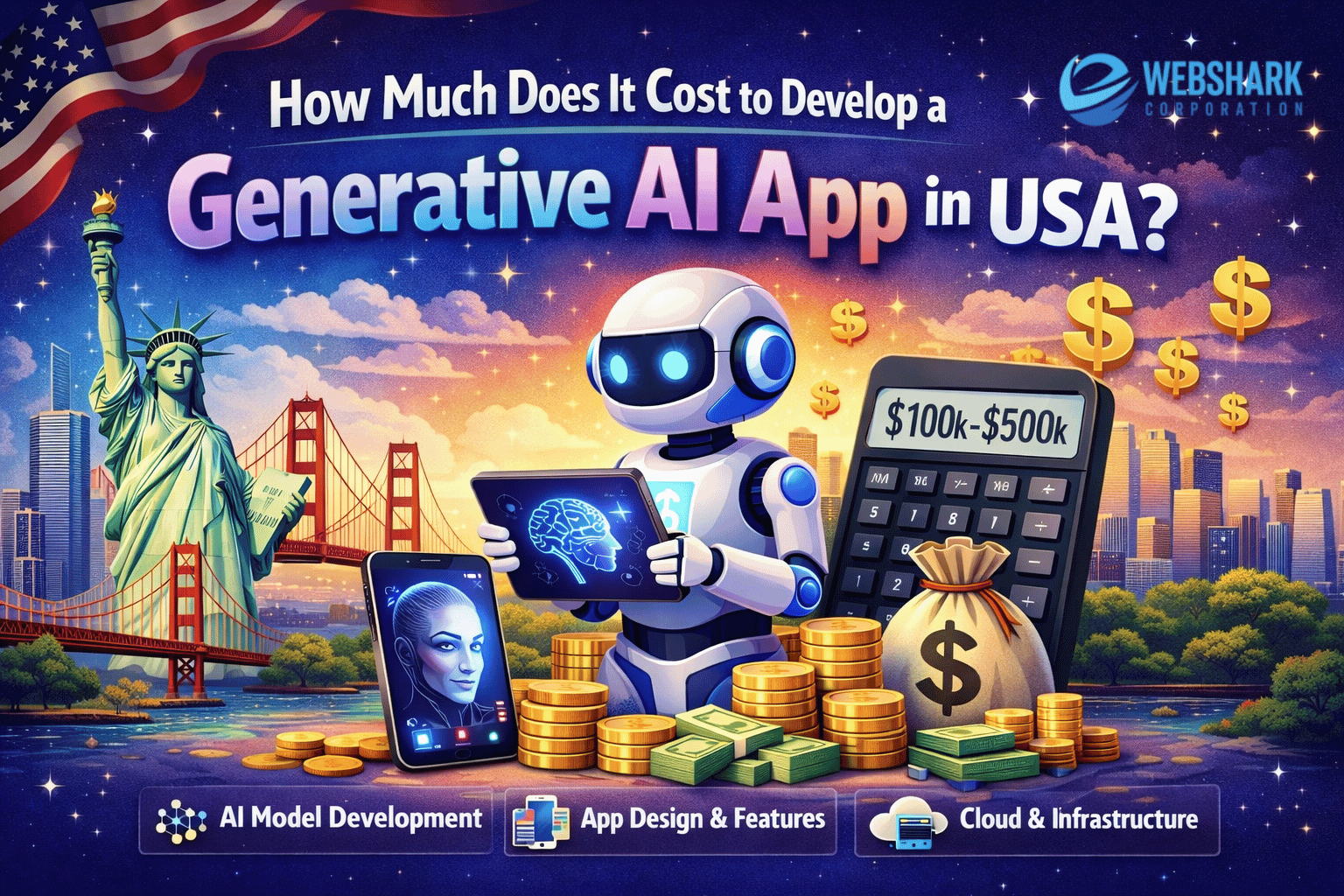
- A basic generative AI app in the USA typically costs $80,000 to $150,000, a mid-range app $150,000 to $300,000, and enterprise platforms $300,000 to $1 million or more.
- Ongoing costs matter as much as the build: model API usage, cloud hosting, maintenance and compliance can add tens of thousands of dollars a year.
- Using established model APIs such as OpenAI GPT, Google Gemini or Anthropic Claude is the fastest and cheapest way to launch; custom models make sense later.
- AI adoption is mainstream: nearly nine in ten organizations use AI in at least one function, according to McKinsey.
- Starting with an MVP focused on one high-value workflow can cut initial costs by 40% to 50%.
Understanding Generative AI Development
Before we dive into costs, it’s important to understand what we’re actually building.
Generative AI apps use sophisticated machine learning models to create entirely new content. This isn’t just about processing or analyzing existing data, these applications generate fresh outputs based on user prompts and training data.
Think of wildly successful applications like ChatGPT, DALL-E, Midjourney, or Jasper AI. These platforms don’t just retrieve information from databases. They create original text, generate unique images, write functional code, compose music, and even produce video content.
The technology behind these apps involves complex neural networks, massive datasets, and sophisticated algorithms that learn patterns and relationships. This isn’t your standard mobile app development project.
Building such sophisticated technology requires specialized expertise that goes far beyond traditional software development. That’s precisely where partnering with an experienced Mobile app development company in USA becomes absolutely essential.
The right development partner understands not just the coding requirements, but also the business implications, user experience considerations, and ethical dimensions of deploying AI-powered applications.
What Influences Development Costs?
Several critical factors determine your final investment when creating a Generative AI App in USA. Understanding these variables helps you budget more accurately and make informed decisions about where to allocate resources.
App complexity sits at the very top of this list. A straightforward AI chatbot that answers basic customer service questions costs significantly less than a comprehensive multi-functional platform featuring image generation, voice recognition, personalized recommendations, and real-time learning capabilities.
The difference between these applications isn’t just marginal, it can represent hundreds of thousands of dollars in development costs.
Technology stack matters tremendously in the final price tag. Are you planning to use OpenAI’s GPT models, Google’s Gemini models, Anthropic’s Claude, or build completely custom solutions from the ground up?
Each approach comes with different licensing requirements, integration complexities, and ongoing operational costs. Third-party APIs offer faster deployment but ongoing usage fees, while custom models require massive upfront investment but potentially lower long-term costs.
Development team location and expertise dramatically impacts your budget. Working with a Top Mobile app development company in USA ensures quality, compliance with American business standards, and easier communication, but commands premium rates compared to offshore alternatives.
Global teams with US project management can lower costs significantly, so compare communication, process and AI experience as carefully as hourly rates.
Feature set and functionality directly correlate with costs. Every additional feature, whether it’s multi-language support, image recognition, voice synthesis, or advanced analytics, adds development time and complexity.
Data requirements can’t be overlooked. Generative AI apps need substantial amounts of quality training data. Acquiring, cleaning, organizing, and preparing this data represents a significant portion of your budget that many businesses initially underestimate.
Security and compliance needs vary dramatically by industry. Healthcare apps dealing with patient data, financial services applications, or any platform handling sensitive personal information require additional security layers, encryption protocols, and compliance certifications that increase costs substantially.
Breaking Down the Cost Components
Let’s get extremely specific about where your money actually goes when building a Generative AI App in USA.
| Development Phase | Cost Range | Description |
|---|---|---|
| Planning & Research | $5,000 – $15,000 | Market analysis, competitor research, technical feasibility studies |
| UI/UX Design | $10,000 – $30,000 | Interface design, user experience mapping, wireframes, prototypes |
| Backend Development | $50,000 – $150,000 | Server architecture, database setup, API integration, infrastructure |
| AI Model Integration | $20,000 – $100,000+ | Third-party API implementation or custom model training |
| Frontend Development | $20,000 – $60,000 | User interface coding, responsive design, cross-platform compatibility |
| Quality Assurance | $10,000 – $25,000 | AI output testing, bug fixes, performance optimization, security audits |
Planning and research typically runs between $5,000 to $15,000. This foundational phase includes comprehensive market analysis, competitor research, user persona development, and technical feasibility studies.
Skipping or rushing this phase is one of the biggest mistakes companies make. Proper planning prevents costly pivots and rework later in development.
UI/UX design for generative AI apps ranges from $10,000 to $30,000. The interface needs to be exceptionally intuitive because AI interactions can be complex and intimidating for everyday users.
Your design team must create interfaces that make sophisticated AI capabilities feel simple and accessible. This includes wireframing, prototyping, user testing, and multiple design iterations.
Backend development represents your largest single expense, typically ranging from $50,000 to $150,000. This includes server architecture, database configuration, API integrations, and the fundamental infrastructure that powers your application.
The backend must handle potentially millions of AI requests, manage user data securely, and scale efficiently as your user base grows.
AI model integration and training varies wildly based on your approach. Using established third-party APIs like OpenAI might cost $20,000 to $50,000 in development and integration time.
Building and training completely custom models can easily exceed $100,000 and potentially reach several hundred thousand dollars for sophisticated applications.
Frontend development typically costs $20,000 to $60,000 for a polished, responsive interface that works seamlessly across web browsers, iOS devices, and Android platforms.
Users interact with your frontend, so it must be flawless. Every button, animation, and response must work perfectly to maintain user trust in your AI capabilities.
Quality assurance and testing shouldn’t be overlooked or underfunded. Budget $10,000 to $25,000 for comprehensive testing of AI outputs, user experience flows, security vulnerabilities, and performance under various conditions.
AI applications require unique testing approaches because outputs vary based on inputs. Your QA team must test thousands of scenarios to ensure quality and appropriate responses.
Small vs. Enterprise-Level Applications
Not all AI apps are created equal. Let’s examine three distinct categories and their associated costs.
A basic Generative AI App in USA with limited features starts around $80,000 to $150,000.
This category typically includes simple text generation using established third-party APIs, basic user authentication and profile management, a clean mobile and web interface, and standard analytics tracking.
These applications work perfectly for startups testing market viability, small businesses automating specific tasks, or companies launching MVPs to gather user feedback before investing in more sophisticated features.
Mid-range applications with moderate complexity fall between $150,000 and $300,000.
These apps typically feature multiple AI capabilities (text and image generation, for example), robust user personalization engines, comprehensive data analytics dashboards, integration with existing business systems like CRMs or ERPs, and enhanced security protocols.
Mid-range applications suit established businesses expanding their digital offerings, companies serving professional user bases with sophisticated needs, and organizations requiring custom integrations with legacy systems.
Enterprise-level generative AI platforms exceed $300,000 and frequently reach $1 million or more.
We’re talking about custom-trained models tailored to specific industry needs, advanced security protocols meeting stringent compliance requirements, scalability supporting millions of concurrent users, comprehensive admin controls and user management, white-label capabilities for reselling, and dedicated support infrastructure.
Enterprise solutions serve large corporations, SaaS providers building AI into their platforms, and organizations in heavily regulated industries requiring complete control over their AI stack.
| App Category | Total Cost | Key Features | Development Time |
|---|---|---|---|
| Basic AI App | $80,000 – $150,000 | Simple text generation, basic UI, third-party APIs, standard security | 3–4 months |
| Mid-Range App | $150,000 – $300,000 | Multiple AI features, personalization, analytics, business integrations | 5–8 months |
| Enterprise Solution | $300,000 – $1,000,000+ | Custom models, advanced security, full scalability, white-label options | 9–18 months |
The Advantage of Working with Webshark Corporation
Choosing the right development partner can absolutely make or break your Generative AI App in USA project.
Webshark Corporation stands out as a Best Mobile app development company USA with deep, proven expertise in AI technologies and machine learning implementations.
Their team doesn’t just understand code, they grasp both the technical complexities of AI development and the business implications of deploying these powerful tools. This dual perspective ensures your app isn’t just technologically sound but also commercially viable and strategically aligned with your business objectives.
Working with a Top Mobile app development company USA like Webshark Corporation means you get transparent pricing with no hidden surprises, realistic timelines based on actual project experience, ongoing support after launch (not just a handoff), and access to specialists across AI, UX design, backend architecture, and mobile development.
Webshark Corporation has successfully delivered numerous AI projects across industries including healthcare, finance, education, and e-commerce. Their proven track record means fewer costly mistakes and faster time to market.
When you’re investing six figures or more in a Generative AI App in USA, the quality of your development partner directly impacts your return on investment.
Webshark’s AI work is visible in its own products and client builds. Webshark Health is a Gen-AI powered personal health record app live on iOS and Android, and the Tender 9 platform uses AI to summarize long tender documents and power competitor analytics, with a companion React Native app. Webshark is headquartered in Bengaluru, India, with an office in Atlanta, Georgia, holds ISO 27001 and CMMI Level 3 certifications, and is rated 4.8/5 from 129 reviews on Google (as of October 2026).
Explore Webshark’s AI chatbot development, AI agent development and AI-powered website services.
Ongoing Costs You Can’t Ignore
Here’s a reality check that surprises many business owners: development costs represent just the beginning. Monthly operational expenses add up quickly for any Generative AI App in USA.
| Ongoing Expense | Monthly Cost | Annual Cost |
|---|---|---|
| API Usage Fees | $500 – $10,000+ | $6,000 – $120,000+ |
| Cloud Hosting & Infrastructure | $1,000 – $5,000 | $12,000 – $60,000 |
| Maintenance & Updates | , | 15–20% of development cost |
| Security & Compliance | , | $10,000 – $30,000 |
| Customer Support | $2,000 – $8,000 | $24,000 – $96,000 |
API usage fees for services like OpenAI, Google, or Anthropic can range from $500 to well over $10,000 monthly depending on your user volume and feature complexity.
These costs scale directly with success, more users mean higher API bills. Budget conservatively and plan for growth.
Cloud hosting and infrastructure typically costs $1,000 to $5,000 monthly for mid-sized applications running on platforms like AWS, Google Cloud, or Azure. Enterprise solutions with millions of users might exceed $10,000 monthly.
This includes server costs, data storage, bandwidth, content delivery networks, and backup systems.
Maintenance and updates require approximately 15-20% of your initial development cost annually. For a $200,000 app, that’s $30,000 to $40,000 yearly.
This covers bug fixes, performance optimization, compatibility updates for new operating systems, and minor feature enhancements.
Security updates and compliance especially for apps handling sensitive personal data, add another $10,000 to $30,000 annually.
This includes security audits, penetration testing, compliance certifications, and implementing patches for newly discovered vulnerabilities.
Customer support costs vary based on your user base and support model. Expect $2,000 to $8,000 monthly for a combination of automated systems and human support staff.
AI apps often require more sophisticated support because users have questions about AI capabilities, appropriate use cases, and troubleshooting unique scenarios.
Hidden Costs That Surprise Businesses
Many companies underestimate several crucial expenses that emerge during development and launch.
| Hidden Cost | Price Range | Why It Matters |
|---|---|---|
| Data Preparation & Cleaning | $15,000 – $40,000 | Clean, organized data is essential for quality AI outputs |
| Legal & Compliance Reviews | $5,000 – $20,000 | Critical for regulated industries and avoiding legal issues |
| User Training & Documentation | $8,000 – $15,000 | Ensures proper adoption and reduces support burden |
| Marketing & User Acquisition | $20,000 – $100,000+ | Often matches or exceeds development costs |
| Third-Party Integrations | $10,000 – $40,000 | Connecting to CRMs, payment systems, analytics platforms |
Data preparation and cleaning often costs $15,000 to $40,000 before model training even begins. AI systems are only as good as their training data.
Garbage in, garbage out isn’t just a saying, it’s reality. Quality data preparation directly impacts your AI’s performance, accuracy, and usefulness.
Legal and compliance reviews for AI applications run $5,000 to $20,000, especially if you’re operating in regulated industries like healthcare, finance, or education.
You need legal review of terms of service, privacy policies, data handling procedures, and AI-specific regulations that vary by state and industry.
User training and documentation shouldn’t be afterthoughts. Budget $8,000 to $15,000 for comprehensive user guides, video tutorials, onboarding flows, and help documentation.
Well-trained users get more value from your app, require less support, and become stronger advocates for your product.
Marketing and user acquisition deserve their own substantial budget, frequently matching or exceeding your development costs.
The best AI app in the world generates zero ROI without users. Plan for search advertising, content marketing, social media campaigns, influencer partnerships, and PR efforts.
Third-party integrations with CRMs, payment processors, analytics platforms, and business tools add $10,000 to $40,000 to your project.
Each integration requires development time, testing, and ongoing maintenance as those platforms update their APIs.
Ways to Reduce Development Costs
Smart businesses find ways to optimize spending without sacrificing quality when launching their Generative AI App in USA.
Start with a minimum viable product (MVP) that focuses exclusively on core features. Build what users absolutely need first, then expand based on real user feedback rather than assumptions.
This approach can cut initial development costs by 40-50% while getting you to market faster and reducing risk.
Leverage existing AI APIs instead of building completely custom models from scratch. While custom models offer uniqueness and control, established APIs from OpenAI, Google, or Anthropic provide faster deployment and significantly lower upfront costs.
You can always develop custom models later once you’ve proven market demand and generated revenue.
Choose an experienced AI development partner with extensive, proven AI experience. Webshark Corporation brings efficiency from previous projects, established best practices, and reusable components that dramatically reduce trial-and-error expenses.
Experienced developers know which approaches work and which pitfalls to avoid, saving you time and money.
Phased development spreads costs over time and allows revenue generation to fund later phases. Launch with essential features that solve your users’ primary pain point, then add advanced capabilities as revenue grows.
This approach also reduces financial risk and allows course correction based on market response.
Use open-source tools and frameworks where appropriate. While some components require proprietary technology, many aspects of your app can leverage well-maintained open-source solutions.
Outsource non-core functions like graphic design, technical writing, or initial market research to specialists rather than having your premium development team handle everything.
AI Technology Stack Comparison
Different AI platforms come with varying costs, capabilities, and ideal use cases.
| AI Platform | Best For | Integration Cost | Monthly API Cost | Pros | Cons |
|---|---|---|---|---|---|
| OpenAI GPT models | Text generation, chatbots, content creation | $20,000 – $50,000 | $500 – $5,000+ | Highly capable, well-documented, active community | Usage costs scale quickly |
| Google Gemini | Multi-modal AI, enterprise applications | $30,000 – $70,000 | $800 – $8,000+ | Strong multi-modal capabilities, enterprise support | Higher complexity |
| Anthropic Claude | Safe outputs, reliable performance | $25,000 – $60,000 | $600 – $6,000+ | Strong safety features, excellent reasoning | Costs vary widely by model tier |
| Custom Models | Unique requirements, full control | $100,000 – $500,000+ | Variable hosting costs | Complete control, proprietary advantage | Massive upfront investment |
Choosing the right technology stack for your Generative AI App in USA depends on your specific use case, budget constraints, timeline requirements, and long-term strategic goals.
Generative AI Trends Shaping Costs in 2026
- AI agents: apps increasingly complete multi-step tasks, such as booking, quoting or filing, rather than just answering questions. Agents need more testing and guardrails, which adds to the budget.
- Retrieval-augmented generation (RAG): grounding answers in your own documents and data is now the standard way to make AI accurate for business use.
- Falling model prices: per-token API prices keep dropping, but usage tends to grow faster, so monitor spend closely.
- Security and governance: prompt injection, data leakage and model misuse are real risks. The OWASP Top 10 for LLM Applications is a good checklist.
- Regulation: state AI and privacy laws in the US are evolving, so build consent, logging and human review into regulated use cases.
Timeline Expectations and Planning
Understanding realistic development timelines helps with proper financial planning and business strategy.
Simple AI applications typically take 3-4 months from initial concept to market launch. This includes planning, design, development, testing, and deployment.
Budget accordingly for team salaries, infrastructure costs, and operational expenses during this period. Remember that revenue generation doesn’t begin until after launch.
Moderate complexity projects require 5-8 months of focused development. This timeline includes multiple rounds of testing, user feedback integration, refinement phases, and potentially soft launches before full public availability.
The extended timeline means higher total costs but also reduces launch risks through thorough preparation.
Complex enterprise solutions need 9-18 months or even longer for sophisticated implementations. These timelines include custom model training requiring weeks or months, extensive security audits and compliance certifications, integration with complex existing systems, and thorough testing across numerous scenarios and use cases.
While the extended timeline increases costs, it’s absolutely necessary for applications where failure isn’t an option.
ROI Considerations and Business Value
While development costs for a Generative AI App in USA seem substantial, the return on investment can be truly exceptional.
The value of a generative AI app depends on the use case, but adoption is already mainstream: McKinsey’s State of AI research reports that nearly nine in ten organizations now use AI regularly in at least one business function, and 40% of large organizations are scaling AI agents. The returns businesses most often target are:
- Operational efficiency: faster content creation, document processing and data analysis.
- Lower support and labor costs: AI assistants that resolve routine questions and tasks around the clock.
- Revenue growth: personalization, smarter product discovery and new AI-powered features customers will pay for.
- Customer satisfaction: instant, accurate answers and less waiting.
- Market differentiation: AI capabilities that competitors have not shipped yet.
Measure these against a clear baseline before launch so you can prove ROI, and start with one high-value workflow rather than trying to automate everything at once.
Businesses across industries report 30-50% efficiency improvements in content creation, customer service, data analysis, and numerous other tasks after implementing well-designed AI applications.
These aren’t marginal gains, they represent transformative business improvements.
Reduced labor costs from automation often completely offset development expenses within 18-24 months for enterprise applications. Tasks that previously required teams of people can be handled by AI systems with minimal human oversight.
Competitive advantages from AI capabilities drive customer acquisition and retention, generating substantial revenue that justifies initial investments.
Companies implementing AI early gain market position, brand recognition, and customer loyalty that creates lasting value.
Choosing the Right Development Partner
Your choice of an experienced AI development partner literally determines whether your project succeeds or fails.
Look for proven generative AI experience with actual case studies and client references specifically related to AI projects. Don’t accept vague claims, demand specifics.
Ask detailed questions: What AI platforms have you worked with? What challenges did you encounter and how did you solve them? Can I speak with previous clients?
Technical expertise in machine learning, natural language processing, neural networks, and cloud infrastructure is absolutely non-negotiable.
Your development team should include specialists who understand AI at a deep level, not just developers who’ve read articles about ChatGPT.
Communication transparency matters enormously throughout a complex, expensive project. The best firms explain technical concepts clearly, provide regular progress updates, and involve you in key decisions.
Poor communication leads to misaligned expectations, costly rework, and project failures.
Webshark Corporation checks all these boxes as an experienced AI development partner, combining deep technical prowess with strong business acumen and exceptional client communication.
Their team has delivered successful AI projects across multiple industries and can guide you through technical decisions, business strategy, and market positioning.
Making Your Investment Decision
Developing a Generative AI App in USA represents a significant financial commitment that demands careful consideration and strategic planning.
Budget realistically for both upfront development costs and ongoing operational expenses. Underfunding your project leads to incomplete implementations, technical debt, and ultimately failure.
It’s far better to start with a well-funded MVP than an underfunded comprehensive platform.
Start strategically with features that deliver immediate, measurable value to your target users. Build momentum through early wins that demonstrate ROI and justify additional investment.
Partner wisely with experienced developers who truly understand AI’s nuances, capabilities, and limitations. The cheapest development option rarely delivers the best results.
Remember that failed projects cost far more than premium developers.
Plan for scale even if you’re starting small. Your architecture, technology choices, and business model should accommodate growth without requiring complete rebuilds.
Frequently Asked Questions
How much does it cost to build a generative AI app in the USA?
Most generative AI apps cost $80,000 to $300,000 to build, depending on features, integrations and whether you use model APIs or custom models. Enterprise platforms can exceed $1 million.
How much do AI API costs add each month?
API usage typically runs from $500 to more than $10,000 a month, depending on users, features and the models you choose. Costs grow with usage, so budget for success.
Should I use OpenAI, Gemini or Claude, or build my own model?
Start with an established API for speed and lower upfront cost, and design your app so you can switch models later. Custom or fine-tuned models make sense once you have proven demand and unique data.
How long does it take to build a generative AI app?
A basic app takes 3 to 4 months, a mid-range app 5 to 8 months and an enterprise platform 9 to 18 months.
How can I reduce generative AI development costs?
Launch an MVP around one workflow, use existing model APIs and open-source tools, phase advanced features, and work with a team that already has AI delivery experience.
Is my data safe when using AI APIs?
Major providers offer enterprise terms that exclude your data from model training, but you still need encryption, access controls, data minimization and logging. Regulated industries may need additional agreements, such as a HIPAA business associate agreement.
Final Thoughts
Generative AI app development in the USA typically ranges from $80,000 for basic applications to well over $1 million for sophisticated enterprise solutions.
Your specific costs depend on complexity, desired features, chosen technology stack, timeline constraints, and development partner selection.
Working with an experienced AI development partner like Webshark Corporation ensures your substantial investment translates into a powerful, scalable application that drives real, measurable business value.
The AI revolution isn’t waiting for anyone. Companies that move decisively and strategically now will capture significant market share, build strong competitive moats, and establish themselves as industry leaders before competition intensifies.
Ready to explore what generative AI can do for your specific business? The investment might be substantial, but the potential returns, in efficiency, revenue, competitive advantage, and market position, are truly transformative.
Your next critical step is choosing the right experienced AI development partner to bring your vision to life with technical excellence and business insight.