
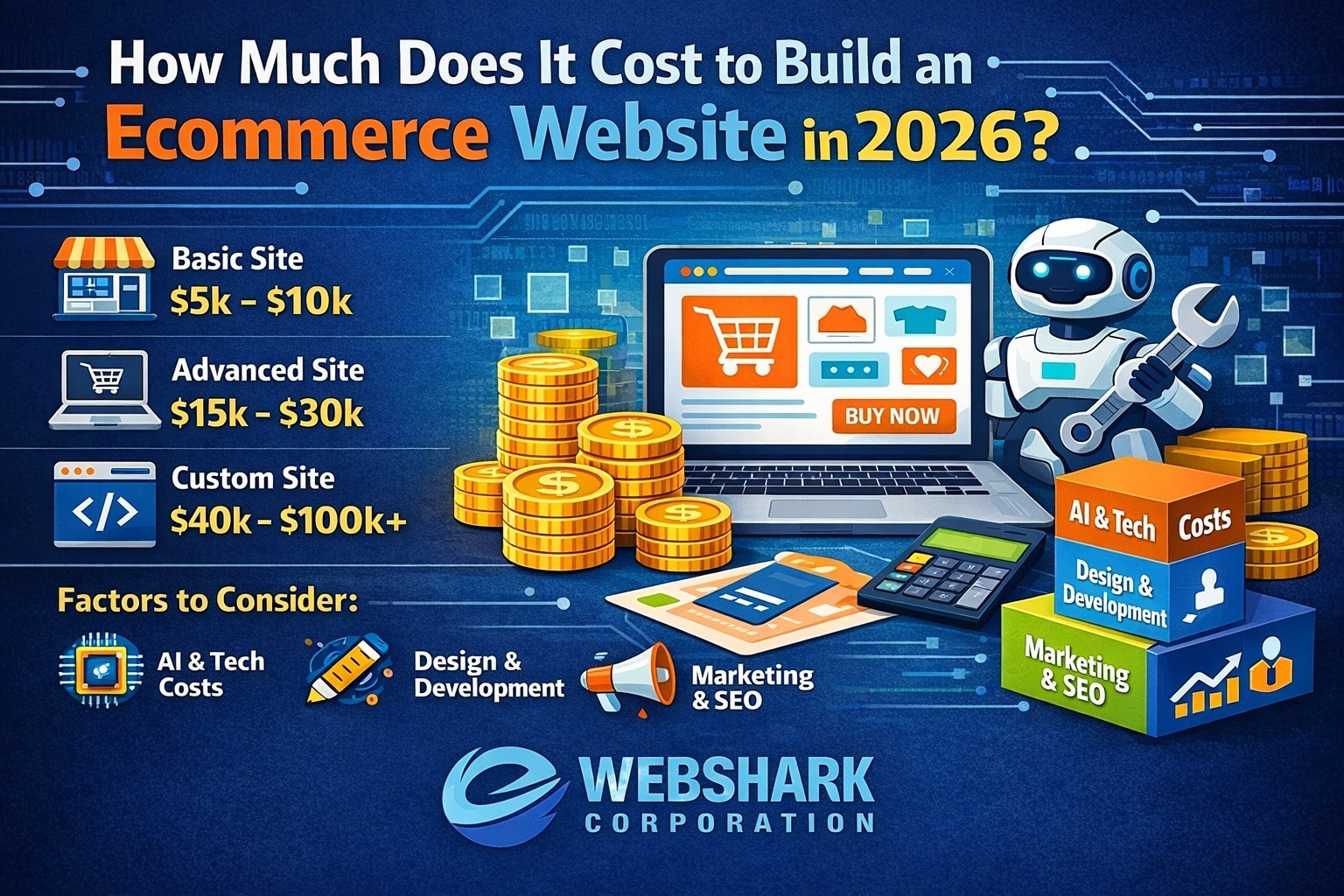

You’re looking at anywhere from $3,000 to $500,000. That range isn’t helpful, I know. But here’s what matters: what you actually need, not what some agency wants to sell you.
Most businesses building an ecommerce website in 2026 will spend between $15,000 and $75,000 for something that works and scales. Anything less usually means cutting corners you’ll regret. Anything more requires justification.
At Webshark Corporation, we’ve built 200+ ecommerce sites. We’ve seen businesses waste $50,000 on features they never use and others cripple their growth by spending $8,000 on a platform they outgrew in six months. This guide shows you what actually drives costs and where your money goes.
What Determines Your Ecommerce Website Cost?
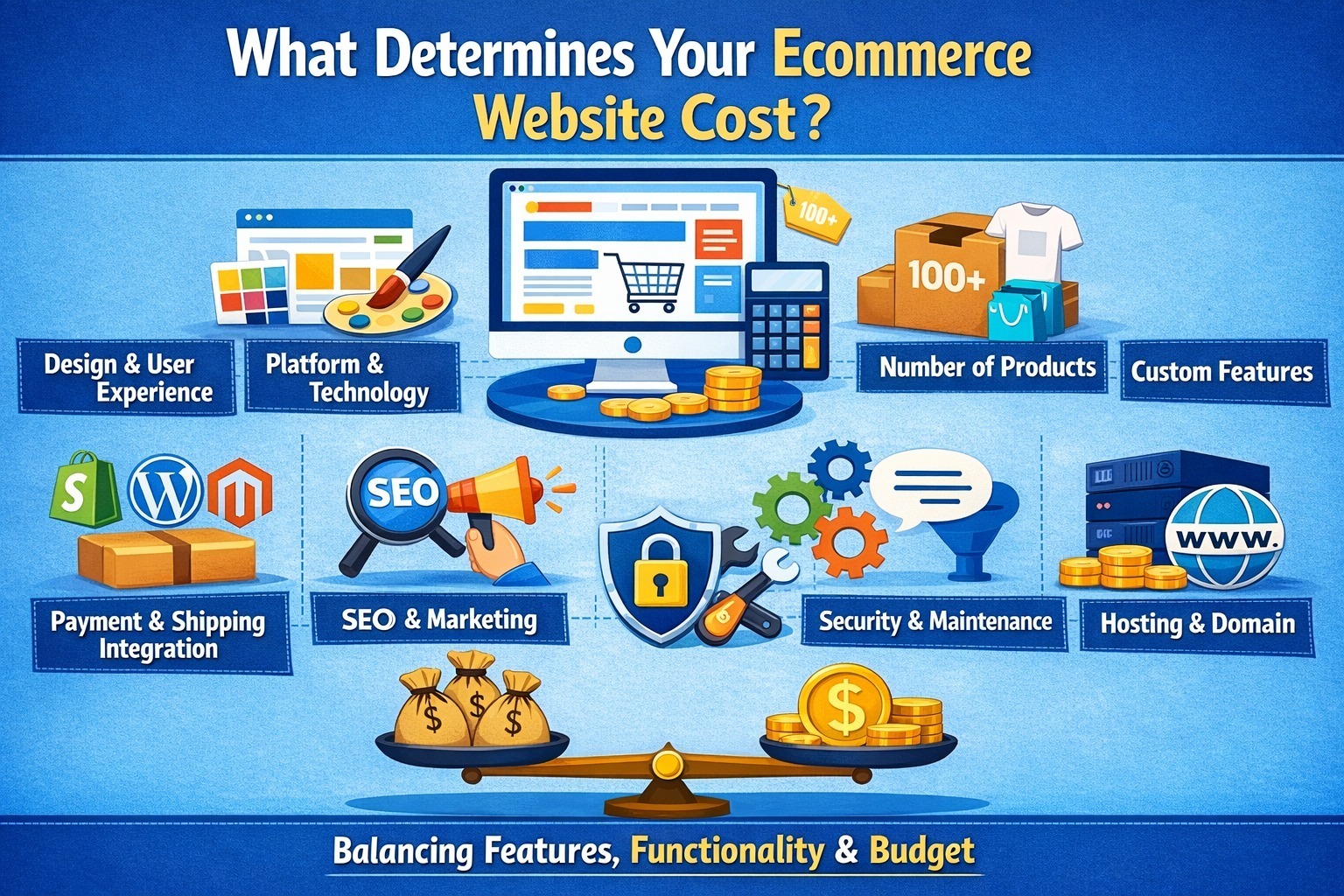
Three factors matter more than everything else combined:
Your Product Catalog Size and Complexity Selling 50 handmade products is different from selling 10,000 SKUs across 20 categories. A site with simple products (t-shirts, books, accessories) costs 40-60% less than one with configurable products (custom furniture, bulk ordering, subscription boxes).
Example: A boutique selling 100 items needs basic inventory management. A distributor with 5,000 SKUs needs automated reordering, supplier integrations, and bulk pricing rules. That difference adds $20,000-$40,000 to development costs.
Your Integration Requirements Every system that needs to talk to your ecommerce website adds cost. Accounting software, CRM, email marketing, shipping carriers, inventory management, ERP systems—each integration runs $2,000-$8,000 depending on complexity.
Most businesses need 3-5 integrations minimum. Budget accordingly.
Your Customization Needs Template modifications are cheap. Custom functionality isn’t. If your checkout process, pricing rules, or user experience needs to work differently than out-of-the-box solutions, expect custom development at $125-$200/hour.
The Real Cost Breakdown
Here’s what you’re actually paying for when you build an ecommerce website:
Platform and Hosting
When Shopify Makes Sense:
- Revenue under $5M annually
- Product catalog under 5,000 items
- Standard business model
- Limited technical team
- Need to launch quickly (under 12 weeks)
When Magento Makes Sense:
- Revenue exceeding $10M annually
- Complex pricing or product configurations
- Heavy customization requirements
- In-house development team
- B2B with custom workflows
The Middle Ground: Between $5M-$10M in revenue, either can work. Shopify Plus ($2,000/month) handles most mid-market needs. Magento gives more control but requires more resources. Webshark Corporation usually recommends Shopify Plus for this range unless you have specific customization needs that justify Magento’s complexity.
Why US Ecommerce Development Costs More ?
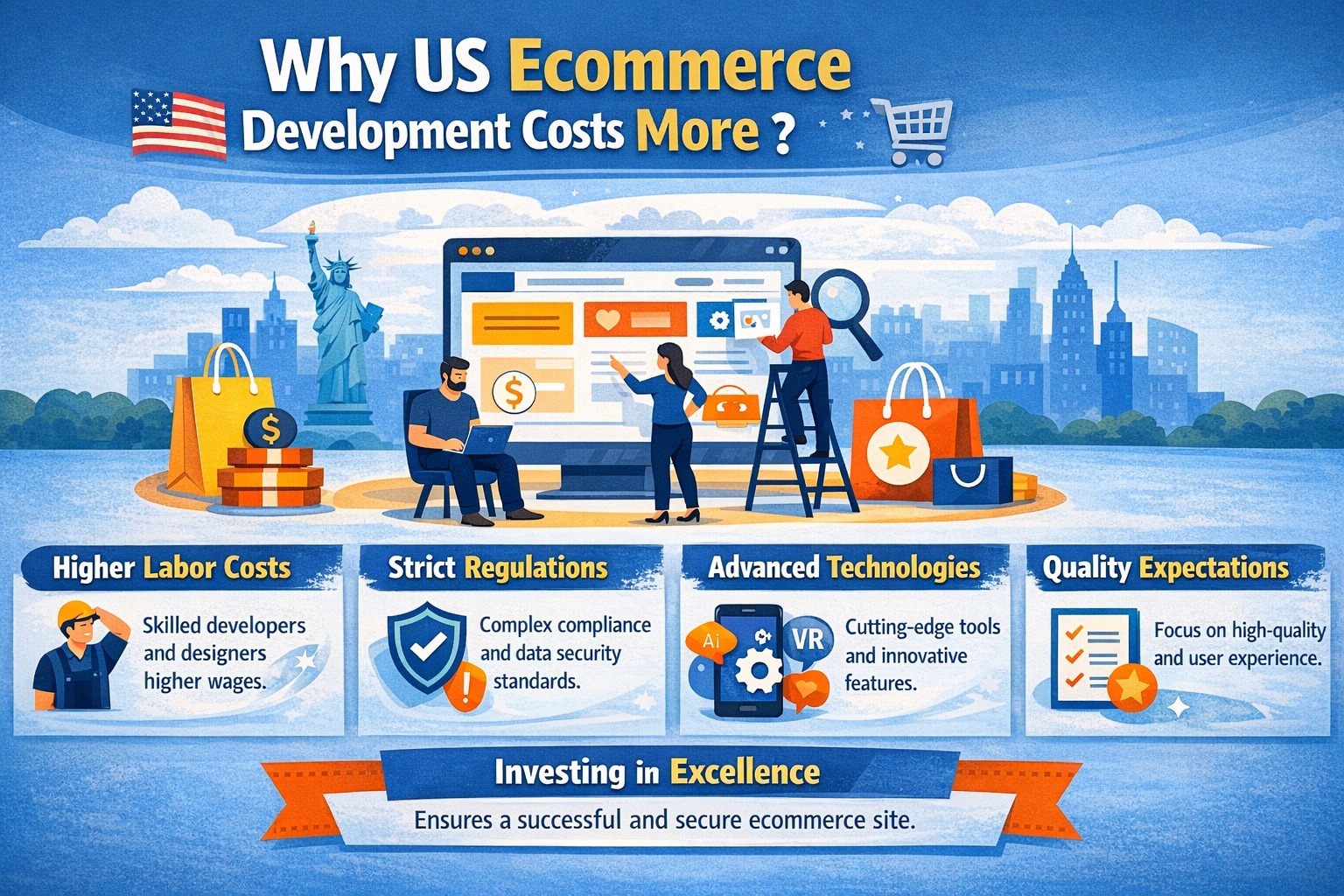
Working with a mobile app development company in USA or domestic agency typically costs 2-3x more than offshore alternatives. Here’s what you get for that premium:
Time Zone Alignment Your developer is available during your business hours. Questions get answered in minutes, not days. When you’re pushing for a holiday launch, this matters enormously.
A client came to us after spending six months with an offshore team. They’d spent $35,000 and had a half-finished site riddled with bugs. We rebuilt it in 10 weeks for $55,000. Total cost was higher, but they launched for Black Friday instead of missing the entire holiday season.
Communication Quality Technical requirements get lost in translation. “The checkout should show applied discounts before shipping” seems clear until you see five different interpretations. US-based teams understand business context, not just technical specs.
Legal Compliance Built-In US developers know ADA accessibility requirements, CCPA, sales tax collection rules, and payment card security standards. Offshore teams often don’t, leaving you exposed to lawsuits and compliance issues.
ADA website lawsuits increased 300% from 2020 to 2025. A single lawsuit costs $20,000-$50,000 to settle. Accessibility compliance adds $5,000-$12,000 to development but eliminates this risk.
Code Quality and Documentation US agencies typically follow modern development standards, write documented code, and build for maintainability. When you eventually need to make changes or switch developers, clean code saves thousands.
We’ve taken over 40+ projects from offshore teams. Average cost to clean up and document the codebase: $15,000-$30,000. That’s before adding any new features.
Project Management Structured workflows, clear milestones, transparent communication. You know what’s happening and when. Offshore projects often lack this structure, leading to scope creep and missed deadlines.
Typical Hourly Rate Comparison:
- US senior developer: $150-$250/hour
- Eastern European developer: $50-$100/hour
- Indian/Southeast Asian developer: $25-$60/hour
A $30,000 Shopify site might cost $12,000 offshore. But factor in:
- 40% longer timeline due to communication delays
- $8,000 in bug fixes post-launch
- $5,000 for accessibility remediation
- Lost revenue from delayed launch
The “savings” disappear quickly.
Real Ecommerce Cost Mistakes Businesses Make
We’ve watched businesses waste serious money on these mistakes. Learn from them:
Mistake #1: Building on the Wrong Platform
A furniture retailer spent $45,000 building a custom WooCommerce site because their nephew “knew WordPress.” Six months later, they were processing 200 orders daily and the site crashed every weekend. They needed Shopify Plus, which would have cost $35,000 and actually scaled.
Migration to Shopify Plus: $28,000. Total waste: $45,000.
The Fix: Match platform to your 3-year revenue projection, not your current size. Planning to hit $2M in revenue? Build for that scale now.
Mistake #2: Skipping Mobile Optimization
A client saved $8,000 by using a desktop-focused design. Their mobile conversion rate was 0.8% versus the industry average of 2.1%. With 70% mobile traffic and 5,000 monthly visitors, that 1.3% difference cost them 65 lost sales monthly.
At $150 average order value: $9,750 in lost monthly revenue. The $8,000 savings cost them $117,000 annually.
Mobile optimization isn’t optional in 2026. It’s where your customers are.
Mistake #3: Ignoring Load Speed
Every second of load time reduces conversions by 7-10%. A site that takes 5 seconds to load versus 2 seconds loses 21-30% of potential sales.
Basic hosting costs $50/month. Quality hosting with CDN costs $200/month. That $150 monthly difference seems significant until you realize a 20% conversion drop on a $50,000 monthly revenue business costs $10,000 monthly.
Webshark Corporation includes performance optimization in every build. It’s not an add-on—it’s fundamental.
Mistake #4: Treating SEO as an Afterthought
Building your site structure without SEO planning is like constructing a store with no signage. Fixing SEO after launch costs 3-4x more than building it in correctly.
Post-launch SEO overhaul: $15,000-$40,000 SEO-first development: $5,000-$12,000 additional during build
The difference: ranking for “handmade leather bags” (8,000 monthly searches) versus “custom artisan leather accessories online shop” (30 monthly searches).
Mistake #5: Underestimating Content Needs
Your ecommerce website needs:
- Product descriptions (200-400 words each for SEO)
- Category page content
- Homepage copy
- About page, shipping info, return policy
- FAQ section
- Blog content for traffic
For a 300-product store:
- Product descriptions at $25 each: $7,500
- Category pages (20) at $150 each: $3,000
- Core pages: $2,000
- Initial blog content: $3,000
- Total: $15,500
Most businesses budget $2,000 for content and wonder why their site doesn’t rank.
Mistake #6: No Post-Launch Budget
Your site needs ongoing work. Period.
Monthly minimums:
- Security updates and patches: $200
- Plugin/theme updates: $150
- Performance monitoring: $100
- Backup management: $50
- Basic support: $500
That’s $1,000/month before adding features, fixing bugs, or making improvements.
Businesses that skip this maintenance end up with security breaches (average cost: $35,000), outdated plugins causing conflicts, and degraded performance.
Hidden Costs Agencies Don’t Tell You
These costs rarely appear in proposals but will appear in your business:
Transaction and Payment Processing
The Obvious Costs:
- Credit card processing: 2.9% + $0.30 per transaction
- PayPal: 3.49% + $0.49 per transaction
The Hidden Costs:
- Monthly gateway fee: $25-$50
- PCI compliance fee: $10-$100/month
- Chargeback fees: $15-$25 per dispute
- International transaction fees: additional 1.5-2%
- Currency conversion fees: 2-3%
On $30,000 monthly revenue:
- Visible fees: $900
- Hidden fees: $150-$300
- Annual hidden costs: $1,800-$3,600
Security and Compliance
SSL Certificate: Free-$200/year (basic)
Advanced Security: $2,000-$5,000/year
- Web application firewall
- DDoS protection
- Malware scanning
- Intrusion detection
PCI Compliance Audits: $1,500-$5,000 annually
ADA Compliance:
- Initial audit: $2,000-$5,000
- Remediation: $5,000-$15,000
- Ongoing monitoring: $500-$1,200/year
Skip these and face lawsuits. ADA compliance lawsuits settle for $20,000-$50,000 on average.
Marketing Technology
Email Marketing:
- 0-1,000 subscribers: $0-$50/month
- 1,000-5,000: $50-$150/month
- 5,000-10,000: $150-$400/month
Integration setup: $2,000-$5,000
SMS Marketing:
- Platform fees: $0.01-$0.05 per message
- 5,000 subscribers, 4 campaigns/month: $400-$1,000/month
Customer Support Tools:
- Help desk software: $50-$300/month
- Live chat: $40-$200/month
- Chatbot: $100-$500/month
Total monthly: $190-$1,000 just for communication tools.
Inventory and Operations
Inventory Management Software:
- Basic: $100-$300/month
- Advanced: $500-$2,000/month
- Integration costs: $3,000-$10,000
Shipping Software:
- Basic shipping: $50-$150/month
- Multi-carrier: $200-$500/month
- Integration: $2,000-$5,000
Returns Management:
- Platform fee: $100-$400/month
- Integration: $2,500-$6,000
Analytics and Optimization
Basic Setup (Included in Most Builds):
- Google Analytics
- Facebook Pixel
- Basic conversion tracking
Advanced Analytics ($200-$800/month):
- Heat mapping tools
- Session recording
- A/B testing platforms
- Advanced attribution
- Customer data platforms
Setup costs: $3,000-$10,000
What You Should Actually Spend
Here’s realistic budgeting based on business size and goals:
Startup (Testing Product-Market Fit)
Budget: $10,000-$25,000
Platform: Shopify Design: Template with minor customization
Development: Standard features only Timeline: 6-10 weeks
This gets you:
- Professional-looking store
- Payment processing
- Basic inventory management
- Mobile-responsive design
- Essential integrations (email, analytics)
You’re not building for scale yet. You’re validating your business model.
Growing Business (Proven Model, Scaling)
Budget: $35,000-$85,000
Platform: Shopify Plus or BigCommerce Enterprise Design: Semi-custom
Development: Custom features for competitive advantage Timeline: 10-16 weeks
This gets you:
- Custom design for key pages
- Advanced filtering and search
- Marketing automation integration
- Customer loyalty features
- Optimized checkout flow
- Performance optimization
- SEO foundation
You’re building for growth. Invest in features that improve conversion and customer lifetime value.
Established Business (Optimizing and Expanding)
Budget: $75,000-$200,000
Platform: Shopify Plus or Magento
Design: Fully custom Development: Advanced features and integrations Timeline: 16-24 weeks
This gets you:
- Complete custom design
- Personalization engine
- Advanced integrations (ERP, CRM, fulfillment)
- Multi-channel selling
- Custom reporting
- International expansion capabilities
- Subscription management
You’re optimizing for profitability and preparing for enterprise scale.
Enterprise (Complex Requirements)
Budget: $200,000-$500,000+
Platform: Magento or custom Design: Fully custom, extensive UX research Development: Extensive custom functionality
Timeline: 6-12 months
This level includes:
- Multi-store management
- Complex B2B functionality
- Custom APIs and integrations
- Advanced inventory management
- Personalization at scale
- Headless architecture
- Dedicated development team
You have unique requirements that off-the-shelf solutions can’t address.
The Webshark Corporation Difference
As a leading mobile app development company in USA, we build ecommerce sites differently. No fluff, no overselling, no surprises.
Our Process
Discovery (Week 1-2): $2,500-$5,000 We analyze your business model, competitors, and technical requirements. You get a detailed specification document and fixed-price quote. If our approach doesn’t fit your budget, we tell you before you waste money.
Design Phase (Week 3-6): $8,000-$30,000 Wireframes first, then visual design. You see exactly what you’re getting before development starts. Unlimited revisions during wireframe stage, two revision rounds during visual design.
Development (Week 7-14): $15,000-$100,000+
Weekly progress updates. Staging site access from week 8. You test features as they’re built, not at the end.
Testing and Launch (Week 15-16): $3,000-$8,000 Comprehensive testing across devices and browsers. Performance optimization. Security hardening. Launch checklist with 100+ items.
Post-Launch (Ongoing): Starting at $1,200/month Monthly security updates, performance monitoring, analytics reporting, and technical support. Optional: ongoing optimization and feature development.
Why Clients Choose Us
Fixed-Price Projects We quote a price, we deliver at that price. No scope creep unless you change requirements.
Transparent Communication Weekly updates. Shared project management system. Direct access to developers when needed.
US-Based Team Everyone you work with is in the US. No handoffs to offshore teams. No time zone issues.
Performance Guarantees Sub-3-second load times or we optimize until we hit it. 95+ Google PageSpeed score.
Security First Every site gets security audit, SSL, PCI compliance setup, and ADA accessibility review.
Calculating Your ROI
A well-built ecommerce website should pay for itself in 12-24 months. Here’s how to evaluate if your investment makes sense:
Example: $40,000 Investment
Assumptions:
- 10,000 monthly visitors (achievable with basic SEO and marketing)
- 2% conversion rate (industry average for optimized sites)
- $85 average order value
- 3 purchases per customer annually
Monthly revenue: 10,000 × 2% × $85 = $17,000 Annual revenue: $204,000
Gross margin (40%): $81,600
Your $40,000 investment pays back in 5.9 months.
Bad Site Performance: Same traffic, 0.8% conversion rate (poor UX):
Monthly revenue: $6,800 Annual revenue: $81,600 Gross margin: $32,640
The $15,000 “cheaper” site costs you $49,000 annually in lost margin. You’re not saving money—you’re losing it.
Making the Decision
Building an ecommerce website in 2026 requires upfront investment. But treating it as an expense instead of a growth tool is the biggest mistake you can make.
Questions to Ask Any Agency
“What’s included in your quoted price?”
If they can’t give you a detailed breakdown, walk away.
“What happens when I need changes after launch?” Understand the maintenance and support model upfront.
“Who owns the code and design files?” You should own everything. If they hedge on this, there’s a reason.
“What’s your testing process?”
“We test it” isn’t an answer. Ask for their QA checklist.
“Can I see similar projects you’ve built?” Live sites, not screenshots. Check performance, mobile experience, and functionality.
Red Flags
- Quotes that seem too good to be true (they are)
- Agencies that push expensive platforms you don’t need
- No clear timeline or project plan
- Reluctance to sign fixed-price agreements
- No post-launch support plan
- Offshore development teams not disclosed upfront
The Bottom Line
Most businesses building an ecommerce website in 2026 should budget $25,000-$75,000 for a professional site that grows with them. Less than $25,000 usually means compromises that hurt performance. More than $75,000 requires clear justification for the additional investment.
Webshark Corporation has built ecommerce sites from $15,000 to $400,000. We’ve learned that success isn’t about spending the most—it’s about spending smartly on what actually drives results.
Ready to discuss your project? We’ll give you straight answers about what you need, what you don’t, and exactly what it will cost. No sales pressure, no inflated quotes, no hidden fees.
Contact Webshark Corporation for a detailed proposal tailored to your business. We build ecommerce sites that perform, scale, and deliver ROI—nothing more, nothing less.