


Last Updated: October 2026 | Reading Time: 15 min
The healthcare industry is going through a digital revolution. Hospitals, clinics, payers and digital health startups across America now depend on custom mobile apps to improve patient care, streamline operations and meet new federal rules on data access. As demand grows, choosing the right healthcare app development company in the USA has become one of the most important technology decisions a healthcare organization makes.
This guide explains what it takes to build a secure, compliant and successful healthcare app in 2026: the app types that matter, must-have features, US regulations, the right tech stack, realistic costs and how to pick a development partner. It also explains how Webshark Corporation approaches healthcare projects, and why we specialize in creating innovative, secure and user-friendly healthcare applications that meet the unique needs of medical providers and patients alike.
Key Takeaways
- Patients already expect digital access: 77% of US individuals were offered online access to their medical records in 2024, and 65% were offered and used it, according to ASTP/ONC.
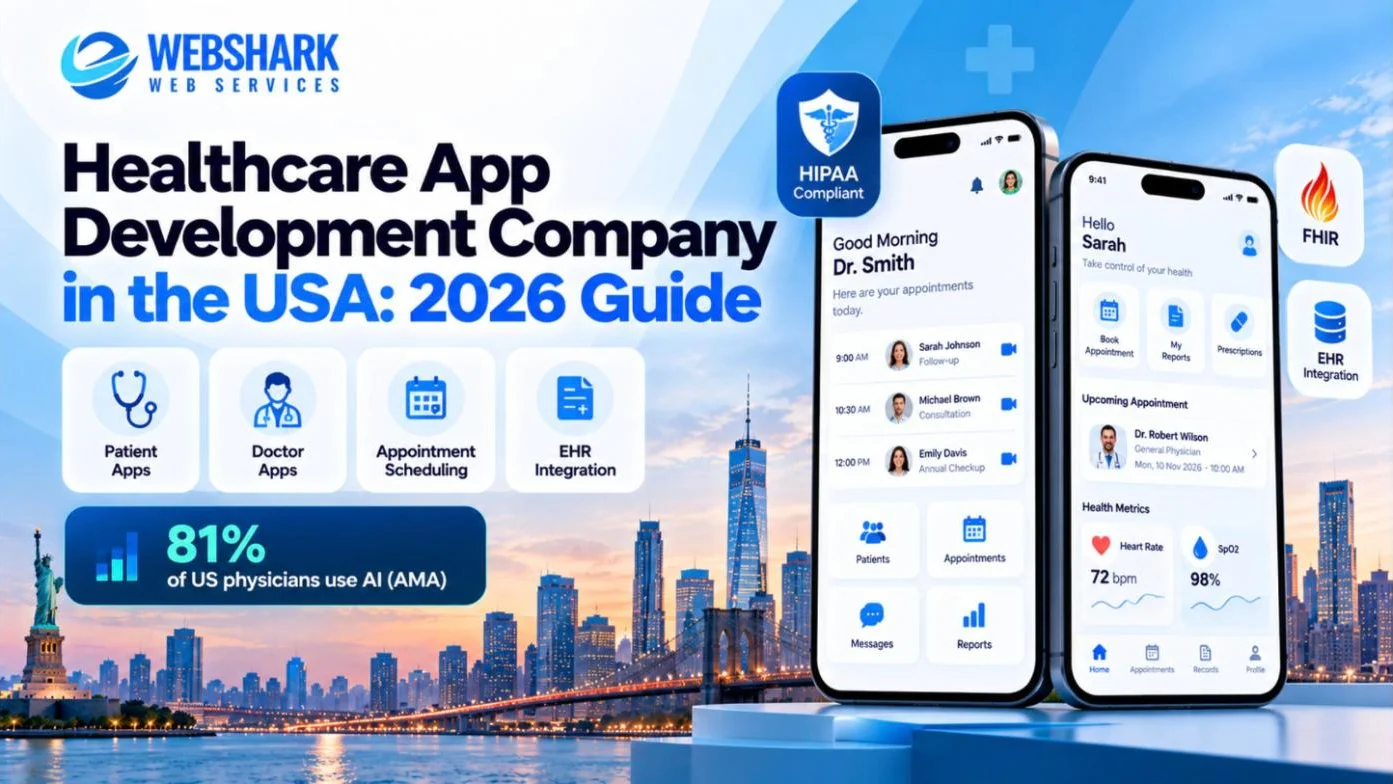
- Clinicians are ready for AI: 81% of US physicians now use AI tools professionally, more than double the 2023 rate, according to the American Medical Association.
- Compliance is non-negotiable: HIPAA penalties now reach up to $2,190,294 per violation category per year after the January 2026 inflation adjustment.
- Interoperability deadlines are close: the CMS Interoperability and Prior Authorization rule requires FHIR-based APIs for many payers by January 2027.
- A realistic budget for a compliant healthcare app ranges from about $30,000 for a simple wellness app to $200,000+ for an EHR-integrated or AI-driven clinical platform.
Why Healthcare Apps Matter in the USA Today
Patient expectations have changed dramatically. People want instant access to their health information, simple appointment scheduling, prescription refills and virtual consultations from home. Healthcare providers need efficient systems to manage patient data, reduce administrative burden and deliver quality care with smaller teams.
The data backs this up. Among US patients who accessed their portal in 2024, 57% did so through a smartphone app, per ASTP/ONC. At the same time, healthcare remains a top target for cybercrime: the HIPAA Journal’s 2025 Healthcare Data Breach Report counted 709 breaches affecting at least 61.5 million people.
That combination is why professional healthcare app development services make all the difference. A well-designed healthcare application bridges the gap between providers and patients while staying compliant with strict medical regulations.
Types of Healthcare Apps You Can Build
Whether you are a small clinic, a multi-location hospital network, a payer or a digital health startup, these are the app categories that deliver the most value in 2026.
Telemedicine Applications
Virtual care is no longer optional. Telemedicine platforms enable secure video consultations, real-time chat, e-prescribing and follow-up care, so patients get convenient access while providers expand their reach beyond physical locations.
Patient Portal and Engagement Apps
Patient portals give people control of their healthcare journey with access to medical records, test results, prescription refills, bills and appointment scheduling in one secure app.
Personal Health Record (PHR) Apps
PHR apps let patients store, organize and share their own records across providers. Webshark has built this category for itself: Webshark Health is our Gen-AI powered personal health record platform, live on iOS and Android.
Remote Patient Monitoring (RPM) Apps
RPM apps connect to wearables and connected devices such as blood pressure cuffs, glucose monitors and pulse oximeters, then alert care teams when readings move outside safe ranges. They are especially valuable for chronic care programs.
Electronic Health Records and Clinical Apps
EHR modules and clinical apps streamline documentation, reduce errors and improve care coordination. Most US projects integrate with existing systems such as Epic, Oracle Health (Cerner) or athenahealth rather than replacing them.
Medical Billing and Revenue Cycle Apps
Billing applications automate claims processing, eligibility checks and payment collection, reducing errors and speeding up reimbursements.
Fitness, Wellness and Mental Health Apps
Preventive care starts with lifestyle. Wellness, nutrition and mental health apps help users track health metrics, set goals and build habits. Even when these apps fall outside HIPAA, they can still be covered by FTC and state health privacy rules, so privacy design still matters.
AI-Powered Healthcare Apps
AI is now part of many healthcare products: symptom checkers, clinical documentation assistants, triage chatbots and predictive analytics. If an AI feature influences diagnosis or treatment, it may count as a medical device under FDA rules, which changes your development and approval plan. Our AI chatbot development and AI agent development teams build these features with clinical guardrails.
Must-Have Features of a Healthcare App
| Feature | For Patients | For Providers |
|---|---|---|
| Secure sign-in | Biometric login, MFA, easy account recovery | Role-based access and audit logs |
| Appointments | Self-scheduling, reminders, waitlists | Calendar sync, no-show reduction |
| Virtual visits | HD video, chat, file sharing | Visit notes, e-prescribing, follow-ups |
| Health records | Lab results, medications, visit history | EHR integration through FHIR APIs |
| Monitoring | Wearable and device sync | Alerts and dashboards for care teams |
| Payments | Bills, insurance cards, copays | Claims status and eligibility checks |
| Notifications | Medication and appointment reminders | Task and escalation alerts |
| Accessibility | Screen reader support, large text, multiple languages | WCAG-aligned admin interfaces |
US Healthcare Compliance and Regulations Your App Must Meet
Healthcare data is sacred, and in the US it is also heavily regulated. Every application Webshark builds is designed around these rules from the first sprint, not patched in before launch.
| Regulation | Who It Applies To | What It Means for Your App |
|---|---|---|
| HIPAA Privacy and Security Rules | Covered entities and their business associates | Encryption, access controls, audit trails, risk assessments and signed BAAs with every vendor that touches PHI |
| HITECH Act | HIPAA-covered organizations | Breach notification duties and stronger enforcement |
| FDA Software as a Medical Device (SaMD) | Apps that diagnose, treat or guide clinical decisions | Risk classification and possible 510(k) or De Novo review before launch |
| 21st Century Cures Act (ONC/ASTP rules) | Providers, health IT developers and health information networks | Information blocking rules and standardized patient data access |
| CMS Interoperability and Prior Authorization Rule | Medicare Advantage, Medicaid, CHIP and ACA exchange plans | FHIR R4 Patient Access, Provider Access, Payer-to-Payer and Prior Authorization APIs, mostly by January 2027 |
| FTC Health Breach Notification Rule | Health apps not covered by HIPAA | Breach notification for consumer health data |
| State health privacy laws | Apps serving users in states such as California and Washington | Consent, data rights and limits on sharing consumer health data |
The financial risk of getting this wrong keeps rising. After the inflation adjustment effective January 28, 2026, HIPAA civil penalties range from $145 to $73,011 per violation, with annual caps up to $2,190,294 per violation category.
On interoperability, the CMS Interoperability and Prior Authorization Final Rule requires HL7 FHIR Release 4.0.1 APIs, so any payer or provider app planned today should be FHIR-ready. For AI features, the FDA maintains a public list of AI-enabled medical devices that shows how similar products were cleared.
How Webshark Builds Security In
- HIPAA-aligned architecture with data protection, access control and audit trails
- End-to-end encryption for data in transit and at rest
- Multi-factor authentication and role-based permissions
- HIPAA-eligible cloud hosting with signed business associate agreements
- Regular security audits and penetration testing, plus OWASP Mobile Top 10 checks
- An information security program certified to ISO 27001
Healthcare App Tech Stack
Modern healthcare app development requires a stack that is secure, scalable and easy to integrate. Here is what we typically recommend.
| Layer | Common Choices |
|---|---|
| Mobile apps | Swift and SwiftUI (iOS), Kotlin (Android), React Native or Flutter (cross-platform) |
| Web portals | React, Next.js, Angular |
| Backend | Node.js, Python, Java (Spring Boot), Laravel |
| Interoperability | HL7 FHIR R4, SMART on FHIR, HL7 v2 interfaces |
| Cloud | HIPAA-eligible AWS, Microsoft Azure or Google Cloud services |
| Video and messaging | HIPAA-ready video SDKs and secure messaging |
| AI | Large language models with retrieval, clinical NLP and predictive models |
| Devices | Apple HealthKit, Health Connect, Bluetooth medical devices |
Not sure whether to go native or cross-platform? Our comparison of React Native vs Flutter for US startups explains the trade-offs. You can also hire React Native developers or hire Flutter developers directly.
The Webshark Healthcare App Development Process
We follow a proven methodology that keeps your project compliant and on track from concept to launch.
- Discovery and compliance planning: we map your users, clinical workflows, data flows and the regulations that apply, including whether any feature could be regulated by the FDA.
- UX and clinical design: our designers create intuitive interfaces that make complex medical information easy to understand, with accessibility built in so every user can benefit.
- Secure development: we build HIPAA-aligned applications from the ground up, with code reviews and security testing in every sprint.
- Integrations: EHR, lab, pharmacy, payment and device integrations, using FHIR APIs wherever possible.
- Rigorous testing: functional, performance, security and usability testing across devices and real-world scenarios, so issues are caught before they reach patients.
- Launch: App Store and Google Play submission, including health data and privacy disclosures.
- Ongoing support: maintenance, OS updates, security patches and new features to keep your app running smoothly and compliant as rules change.
Not Sure These Costs Apply to Your App?
Get a realistic, personalized cost estimate tailored to your specific idea, goals, and technical needs based on scope, features, and timelines, not vague or generic ranges.
Check My App Cost
How Much Does Healthcare App Development Cost in the USA?
Cost depends on features, integrations and compliance scope. The ranges below reflect typical budgets for professionally built, compliant healthcare apps in 2026.
| App Type | Typical Features | Timeline | Estimated Cost |
|---|---|---|---|
| Wellness or fitness app | Tracking, goals, reminders, wearable sync | 3 to 4 months | $30,000 to $60,000 |
| Patient portal or appointment app | Scheduling, records, messaging, payments | 4 to 6 months | $50,000 to $120,000 |
| Telemedicine app | Video visits, e-prescribing, EHR sync | 5 to 9 months | $80,000 to $200,000 |
| Remote patient monitoring app | Device integration, alerts, care dashboards | 6 to 10 months | $100,000 to $250,000 |
| Enterprise or AI clinical platform | Multi-system integration, AI, possible FDA pathway | 9 to 18 months | $200,000+ |
For context, the average mobile app project listed on Clutch costs about $90,780, and healthcare usually sits above average because of security, compliance and integration work. Budget for ongoing costs too: hosting, security monitoring, compliance audits and updates typically add 15% to 20% of the build cost each year.
Quality healthcare app development is a significant investment, but consider the return: higher efficiency, wider patient reach, better care quality and a stronger reputation. Webshark Corporation works within your budget to deliver maximum value, with transparent pricing, no hidden costs and a phased approach that lets you start with an MVP and scale as you see results. For more on budgeting, see our guides on app development cost for US buyers and generative AI app cost in the USA.
Common Challenges in Healthcare App Development and How to Solve Them
- Legacy EHR integration: plan integrations early and use FHIR APIs or integration engines instead of custom one-off connections.
- Compliance gaps with vendors: only use cloud, video, messaging and analytics providers that will sign a BAA.
- Low patient adoption: design for older users and low digital literacy, keep onboarding short and offer multiple languages.
- Clinician resistance: involve doctors and nurses in design reviews, and fit the app into existing workflows rather than adding steps.
- AI safety: keep a human in the loop, log model outputs and check whether FDA oversight applies before launch.
Why Choose Healthcare Software Development Companies in USA?
Working with a team that has a US presence offers clear advantages. Time zone alignment means real-time communication and faster problem-solving. Cultural understanding ensures applications resonate with American patients and providers.
Healthcare software development companies in USA also understand local regulations closely. HIPAA compliance, state-specific requirements and insurance integration all demand local expertise.
Webshark Corporation proudly serves clients across all fifty states. We understand the American healthcare landscape and build solutions that thrive within it.
If you are comparing US app development partners more broadly, Himanshu Gedam’s guide to the top 10 mobile app development companies in the USA for 2026 on LinkedIn is a useful further read.
Why Webshark Corporation Is a Trusted Healthcare App Development Company
Webshark Corporation understands that healthcare software is not just about technology. It is about saving lives, improving patient experiences and making healthcare more accessible. Our team combines deep technical expertise with practical knowledge of healthcare regulations, because every feature must work flawlessly when patients depend on it.
- Healthcare product experience: we built and run Webshark Health, our own Gen-AI powered PHR app on iOS and Android, so we understand healthcare products from the inside.
- Certified processes: ISO 27001 certified for information security and appraised at CMMI Level 3 for mature delivery.
- Proven scale: 580+ projects delivered for clients across 18+ countries, for brands such as KFC (Yum! Brands), Starbucks, Flipkart and Philips.
- US presence: headquartered in Bengaluru, India, with an office in Atlanta, Georgia, for US clients.
- Client trust: rated 4.8/5 from 129 reviews on Google (as of October 2026).
Real Results for Real Healthcare Providers
Webshark Corporation has partnered with diverse healthcare organizations across America. From small practices to multi-location hospital systems, we have delivered solutions that drive measurable results.
Our clients report reduced administrative costs, improved patient satisfaction scores and increased appointment bookings. Doctors spend less time on paperwork and more time with patients, and patients enjoy convenient access to care on their terms.
The Future of Healthcare Apps: Trends for 2027
- AI documentation and triage: ambient scribes and AI assistants that reduce charting time.
- FHIR everywhere: CMS deadlines in 2027 will push payers and providers toward open, standard APIs.
- Hospital at home: more RPM and connected-device programs for chronic and post-acute care.
- Personal health records: patients increasingly expect to carry their records across providers.
- Stronger privacy expectations: more state health privacy laws and closer scrutiny of consumer health data.
Webshark Corporation stays ahead of these trends, so healthcare providers can prepare for tomorrow while solving today’s challenges.
Frequently Asked Questions
How much does it cost to build a healthcare app in the USA?
Most compliant healthcare apps cost between $50,000 and $250,000. Simple wellness apps can start around $30,000, while EHR-integrated or AI-driven clinical platforms often exceed $200,000.
How long does healthcare app development take?
An MVP usually takes 3 to 6 months. Telemedicine and RPM apps typically take 5 to 10 months, and enterprise platforms with multiple integrations can take 12 months or more.
Does my healthcare app need to be HIPAA compliant?
If your app creates, receives, stores or transmits protected health information on behalf of a covered entity such as a provider, health plan or clearinghouse, yes. Consumer wellness apps may fall outside HIPAA but can still be covered by the FTC Health Breach Notification Rule and state privacy laws.
Does the FDA regulate healthcare apps?
The FDA regulates apps that meet the definition of a medical device, such as software that diagnoses conditions or guides treatment decisions. General wellness and administrative apps usually are not regulated as devices.
What is FHIR and why does it matter?
FHIR (Fast Healthcare Interoperability Resources) is the HL7 standard for exchanging health data through APIs. US federal rules increasingly require FHIR, so building on it makes EHR and payer integrations faster and future-proof.
Should I build a native or cross-platform healthcare app?
Cross-platform frameworks like React Native and Flutter suit most patient-facing apps and reduce cost. Native development is better when you need deep device integration or maximum performance.
Can you integrate my app with Epic or Cerner?
Yes. Most modern EHRs, including Epic and Oracle Health (Cerner), support FHIR APIs and SMART on FHIR apps, which is the approach we recommend for new integrations.
Do you provide support after launch?
Yes. We provide ongoing maintenance, updates, security patches and technical support so your application stays reliable and compliant.
Partner with Webshark Corporation
Choosing the right healthcare app development company in the USA determines your project’s success. With Webshark Corporation, you gain a partner committed to your long-term success, combining healthcare knowledge, technical excellence and genuine care for outcomes.
Whether you need a simple appointment booking app or a comprehensive patient management platform, explore our mobile app development services and custom CRM development, read our step-by-step guide on how to develop an app in the USA, or contact Webshark Corporation for a free consultation. Let’s build something that improves lives and transforms care delivery.