

Introduction
Develop an app in USA is really exciting. It is a process that turns ideas into digital products that make money. If you have an idea for a mobile app or if you are a business that wants to make your digital presence stronger, you need to know how mobile app development works.
The United States is a place to make a mobile app because it has a lot of people who might want to use your app. However, making a mobile app in the United States also has some problems. For example, it can be expensive. There are a lot of other mobile apps out there, so you have to be careful when you are making your mobile app. Understanding the mobile app development process is very important for making a successful mobile app.
The beauty of modern app development lies in global collaboration. While you may be targeting the US market, you can leverage worldwide talent pools to bring your vision to life more efficiently. Many successful American apps have been developed through partnerships with international development teams, particularly from India, where companies like Webshark Corporation deliver world-class quality at competitive prices. This strategic approach allows you to maximize your budget while maintaining the high standards US consumers expect.
Understanding the US App Market Landscape
Before you start making an app you need to know what makes the American app market special. The United States has a lot of people who use smartphones. Over 270 million people. This makes the American app market a good place to sell apps. People in America are happy to pay for apps and services that’re good quality. This is why a lot of developers and entrepreneurs want to make apps for the market. The American app market is a place to make money because American consumers are willing to pay for good apps and services.
The US market is highly competitive, with millions of apps available across both the Apple App Store and Google Play Store. Success requires more than just a good idea—it demands exceptional execution, thoughtful user experience design, robust functionality, and strategic marketing. Understanding your target audience, their pain points, and how your app solves real problems is the foundation of a successful product.
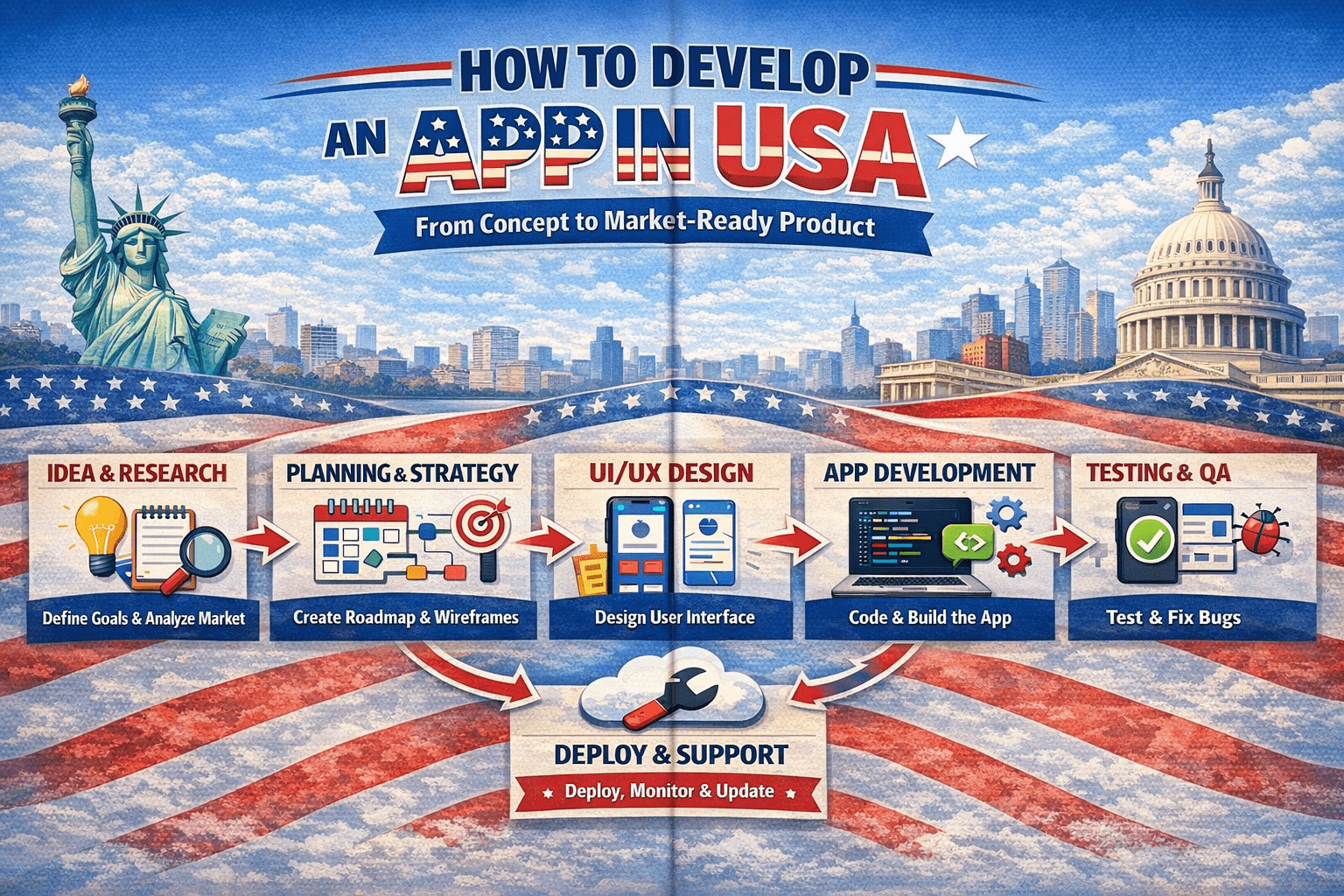
Phase One: From Idea to Validated Concept
Every successful app begins with a clear concept, but not every concept deserves to become an app. The first critical step in your development journey is validating your idea before investing significant resources.
Market Research and Competition Analysis: Start by thoroughly researching your target market. Who are your competitors? What apps currently address similar problems? What are their strengths and weaknesses? Use this information to identify gaps in the market that your app can fill. Download and test competing apps, read user reviews, and understand what users love and hate about existing solutions.
Define Your Target Audience: Create detailed user personas representing your ideal customers. Understand their demographics, behaviors, pain points, and motivations. The more specific you are about your target audience, the better you can tailor your app to meet their needs. American consumers are diverse, so be precise about which segment you’re targeting initially.
Identify Your Unique Value Proposition: What makes your app different? Why should users choose your solution over established competitors? Your unique value proposition should be clear, compelling, and focused on genuine user benefits rather than technical features.
Validate Through Feedback: Before spending thousands on development, validate your concept through surveys, focus groups, or landing page tests. Create a simple pitch deck or prototype and share it with potential users. Their feedback will be invaluable in refining your concept and avoiding costly mistakes later.
Phase Two: Planning and Strategy Development
Once you’ve validated your concept, it’s time to create a comprehensive development plan that will guide your entire project.
Document Your Requirements: Create detailed specifications outlining every feature and function your app should include. This documentation becomes the blueprint for your development team and helps prevent misunderstandings that lead to cost overruns. Include user stories, feature descriptions, technical requirements, and design preferences.
Choose Your Development Approach: Decide whether you’ll build native apps for iOS and Android separately, use cross-platform frameworks, or create a progressive web app. Each approach has trade-offs in terms of cost, performance, and development time.
Budget Planning: Understanding costs is crucial for making informed decisions. While development costs in the US can be substantial, smart entrepreneurs often partner with offshore development teams to optimize their budgets. The app development cost usa is significantly lower than US rates while maintaining high quality standards. Companies like Webshark Corporation offer transparent pricing models that help you maximize value without compromising quality.
| Development Location | Average Hourly Rate | Typical App Cost |
|---|---|---|
| United States | $100 – $250 | $50,000 – $500,000+ |
| India (Premium) | ₹2,500 – ₹4,000 ($30–$50) | ₹8,00,000 – ₹40,00,000 |
| India (Standard) | ₹1,500 – ₹2,500 ($18–$30) | ₹5,00,000 – ₹25,00,000 |
| Eastern Europe | $50 – $100 | $25,000 – $200,000 |
The Mobile App Development cost in USA offers exceptional value, often delivering 60-70% cost savings compared to US-based development while maintaining comparable quality standards.
Timeline Development: Create a realistic timeline accounting for design, development, testing, and deployment phases. Most apps take three to nine months from concept to launch, depending on complexity. Factor in buffer time for unexpected challenges and iterations.
Risk Assessment and Mitigation: Identify potential risks—technical challenges, market changes, resource constraints—and develop mitigation strategies. This proactive approach prevents surprises that derail your project.
Phase Three: Design That Captivates Users
Great design is non-negotiable in the competitive US market. American consumers expect intuitive, beautiful interfaces that make complex tasks feel effortless.
Wireframing and Prototyping: Start with simple wireframes showing the basic structure and flow of your app. These low-fidelity designs allow you to experiment with different layouts and navigation patterns without investing heavily in detailed graphics. Once you’ve refined the structure, create interactive prototypes that simulate the actual user experience.
User Interface Design: Your app’s visual design should align with your brand identity while meeting platform-specific guidelines. iOS and Android have different design languages—iOS follows Human Interface Guidelines while Android follows Material Design principles. A skilled design team understands these nuances and creates platform-appropriate designs.
User Experience Optimization: Design every interaction to be intuitive and frictionless. Consider the complete user journey from onboarding through daily usage. Pay special attention to the first-time user experience—you only get one chance to make a first impression.
Accessibility and Inclusivity: Design for all users, including those with disabilities. Implement proper color contrast, support screen readers, enable dynamic text sizing, and ensure your app is usable by everyone. This isn’t just ethical—it’s also legally important in the US market.
When evaluating the app development price in USA for design services, you’ll find that Indian design teams often provide exceptional value, with skilled designers creating world-class interfaces at rates 50-70% lower than US-based designers.
Phase Four: Development and Technical Implementation
This is where your concept becomes reality. The development phase transforms designs and specifications into a functioning application.
Choosing Your Technology Stack: Select programming languages, frameworks, and tools based on your app’s requirements, target platforms, and scalability needs. For native iOS development, Swift is the preferred language, while Kotlin dominates native Android development. Cross-platform options like React Native or Flutter allow code sharing between platforms, reducing the app building cost in India and development time.
Frontend Development: The frontend team brings your designs to life, implementing the user interface and client-side functionality. This includes creating responsive layouts, implementing animations, integrating with device features like camera and GPS, and ensuring smooth performance across different devices.
Backend Development: Most apps require backend infrastructure for data storage, user authentication, business logic, and API management. Your backend needs to be secure, scalable, and reliable. Cloud platforms like AWS, Google Cloud, or Azure provide robust infrastructure that grows with your user base.
Database Design: Structure your database for efficient data storage and retrieval. Consider data relationships, query patterns, and future scalability. Choose between SQL databases for structured data with complex relationships or NoSQL databases for flexibility and horizontal scaling.
API Integration: Connect your app with third-party services for payments, analytics, social media, maps, and other functionality. Proper API integration enhances your app’s capabilities while saving development time.
| Development Phase | Timeline | Cost in India (₹) | Cost in USA ($) |
|---|---|---|---|
| UI/UX Design | 3–6 weeks | ₹2,00,000 – ₹6,00,000 | $5,000 – $20,000 |
| Frontend Development | 6–12 weeks | ₹4,00,000 – ₹12,00,000 | $15,000 – $50,000 |
| Backend Development | 6–14 weeks | ₹5,00,000 – ₹15,00,000 | $20,000 – $60,000 |
| Testing & QA | 2–4 weeks | ₹1,50,000 – ₹4,00,000 | $5,000 – $15,000 |
| Total Estimated Cost | 4–8 months | ₹12,50,000 – ₹37,00,000 | $45,000 – $145,000 |
The significant difference in the cost for app development in USA versus the US makes offshore development an attractive option for startups and businesses managing tight budgets.
Phase Five: Quality Assurance and Testing
Rigorous testing ensures your app works flawlessly before reaching users. The US market is unforgiving of buggy, slow, or unreliable apps—poor performance leads to negative reviews and rapid user abandonment.
Functional Testing: Verify that every feature works as specified. Test all user flows, edge cases, and error handling. Ensure data validation, form submissions, navigation, and integrations function correctly.
Performance Testing: Measure app speed, responsiveness, and resource consumption. Test under various conditions including poor network connectivity, low battery, and limited storage. Optimize load times and minimize battery drain to meet user expectations.
Security Testing: Protect user data through encryption, secure authentication, API security, and compliance with privacy regulations like CCPA and GDPR. Security breaches can destroy your reputation and expose you to legal liability.
Compatibility Testing: Test on multiple devices, screen sizes, and operating system versions. The US market has diverse device usage patterns—from the latest iPhones to older Android devices—and your app should work well across this spectrum.
User Acceptance Testing: Involve real users in testing before launch. Beta testing programs provide valuable feedback and help identify usability issues your team might have missed. Services like TestFlight for iOS and Google Play Console’s internal testing track make beta testing straightforward.
Working with experienced partners like Webshark Corporation ensures comprehensive testing processes are followed, delivering market-ready products that meet high US quality standards.
Phase Six: App Store Optimization and Preparation
Getting your app approved and discovered in app stores requires strategic preparation.
App Store Guidelines Compliance: Both Apple and Google have strict guidelines for app approval. Review these carefully and ensure your app complies with all policies regarding content, functionality, privacy, and business models. Non-compliance leads to rejection and delays.
Creating Compelling Store Listings: Your app store presence is your digital storefront. Craft a compelling app name, write persuasive descriptions highlighting benefits, create eye-catching screenshots and preview videos, design an attractive app icon, and choose relevant keywords for discoverability.
App Store Optimization Strategy: Implement ASO best practices to improve your app’s visibility in search results. Research keywords your target audience uses, optimize your app title and subtitle, encourage positive reviews, and monitor and respond to user feedback.
Preparing Marketing Materials: Develop promotional assets including press kits, demo videos, website landing pages, social media content, and email campaigns. Your marketing should begin before launch to build anticipation and drive initial downloads.
Phase Seven: Launch and Deployment
Launch day is exciting but it’s just the beginning of your app’s journey.
Soft Launch Strategy: Consider launching in a limited geographic market first to gather real-world data and feedback before your full US launch. This approach allows you to identify and fix issues with minimal risk.
Infrastructure Scaling: Ensure your backend infrastructure can handle your expected user load plus significant overhead. Nothing damages a new app’s reputation faster than crashes during launch due to server overload.
Monitoring and Analytics: Implement comprehensive analytics to track user behavior, engagement, retention, and conversion metrics. Tools like Google Analytics, Mixpanel, or Amplitude provide insights into how users interact with your app.
Customer Support Preparation: Have support channels ready for user questions and issues. Quick, helpful responses to user concerns improve retention and encourage positive reviews.
Phase Eight: Post-Launch Optimization
Successful apps continuously evolve based on user feedback and market trends.
Data-Driven Iteration: Analyze usage data to understand what’s working and what needs improvement. Track metrics like daily active users, session length, retention rates, conversion rates, and user lifetime value. Use these insights to prioritize feature development and improvements.
Regular Updates: Plan regular updates to fix bugs, improve performance, add features, and maintain compatibility with new OS versions. Users expect active development—apps that haven’t been updated in months appear abandoned.
User Feedback Integration: Read and respond to app store reviews, conduct user surveys, run focus groups, and monitor social media mentions. This feedback goldmine reveals what users love, hate, and want to see improved.
Marketing and User Acquisition: Develop ongoing marketing strategies including app store optimization, content marketing, social media campaigns, influencer partnerships, paid advertising, and referral programs. Acquiring users in the competitive US market requires sustained effort and investment.
Monetization Optimization: Test different pricing models, optimize in-app purchase flows, experiment with subscription tiers, and implement effective advertising strategies. Find the balance between revenue generation and user experience.
Cost-Benefit Analysis: US vs India Development
Many successful US apps have been developed through partnerships with Indian development teams, leveraging the app development cost usa advantage while maintaining quality.
Why Consider Indian Development Partners: India has the world’s second-largest English-speaking population, providing clear communication. The technology sector is mature with experienced developers skilled in latest technologies. Time zone differences enable round-the-clock development cycles. Most importantly, the cost savings are substantial without sacrificing quality.
Quality Considerations: The myth that lower costs mean lower quality doesn’t hold true for established Indian development firms. Companies like Webshark Corporation employ rigorous quality standards, employ certified developers, follow international best practices, and maintain transparent communication throughout the development process.
Managing Remote Development: Success with offshore teams requires clear communication protocols, detailed documentation, regular video meetings, using collaborative tools effectively, defining clear milestones and deliverables, and building strong working relationships.
| App Complexity | US Development Cost | India Development Cost | Savings |
|---|---|---|---|
| Simple App | $40,000 – $80,000 | ₹8,00,000 – ₹16,00,000 ($10,000 – $20,000) | 70–75% |
| Moderate App | $80,000 – $180,000 | ₹16,00,000 – ₹36,00,000 ($20,000 – $45,000) | 65–75% |
| Complex App | $180,000 – $500,000+ | ₹36,00,000 – ₹1,00,00,000 ($45,000 – $125,000) | 60–75% |
The Mobile App Development cost in USA provides significant savings that can be reinvested in marketing, additional features, or extending your runway.
Building Your Development Team
Whether you choose local or offshore development, assembling the right team is critical.
In-House vs Outsourced Development: In-house teams offer direct control and communication but require significant investment in salaries, benefits, equipment, and office space. Outsourcing provides flexibility, cost efficiency, access to specialized skills, and faster time to market. Many companies choose a hybrid approach, maintaining product management in-house while outsourcing development.
Key Roles You Need: Every successful app development project requires a project manager to coordinate efforts, UI/UX designers for visual and interaction design, frontend developers for client-side implementation, backend developers for server-side logic, QA engineers for testing, and a DevOps specialist for infrastructure and deployment.
Evaluating Development Partners: When considering firms for development, review their portfolio of similar projects, check client testimonials and references, assess their technical expertise and methodologies, evaluate their communication practices, and understand their post-launch support offerings. Companies like Webshark Corporation demonstrate their capabilities through diverse portfolios and transparent engagement processes.
Legal and Compliance Considerations
Developing an app for the US market involves important legal considerations that cannot be ignored.
Privacy and Data Protection: Comply with state and federal privacy laws including CCPA in California, implement clear privacy policies, obtain proper user consent for data collection, and ensure secure data handling and storage practices.
Intellectual Property Protection: Protect your app through trademark registration for your app name and logo, copyright registration for original content and code, patent applications for truly innovative features, and well-drafted employment and contractor agreements that assign IP rights to your company.
Terms of Service and EULAs: Create comprehensive terms of service governing app usage, liability disclaimers, dispute resolution procedures, and clear refund policies for paid apps or in-app purchases.
Accessibility Compliance: The Americans with Disabilities Act requires digital accessibility. Ensure your app meets WCAG guidelines, supports assistive technologies, and provides alternative access methods.
Monetization Strategies for the US Market
Your monetization strategy should align with your target audience and app category while maximizing revenue potential.
Paid Apps: Charging upfront for downloads works for apps with clear, immediate value, unique functionality, or serving professional markets. However, paid apps face higher user acquisition barriers and work best when positioned as premium solutions.
Freemium Model: Offer core functionality free while charging for premium features. This model allows users to experience your app before committing financially, often resulting in higher user acquisition with conversion to paid tiers driving revenue.
In-App Purchases: Sell virtual goods, additional content, feature unlocks, or consumables within your app. This model works excellently for games, productivity apps, and content platforms.
Subscription Model: Recurring revenue through subscriptions provides predictable income and higher customer lifetime value. This model suits apps delivering ongoing value like content streaming, productivity tools, or software-as-a-service applications.
Advertising: Display ads generate revenue from free users. Balance ad placement carefully to avoid disrupting user experience. Consider offering ad-free premium versions for users willing to pay.
Marketing Your App in the US Market
Building a great app is only half the battle—getting it into users’ hands requires strategic marketing.
Pre-Launch Marketing: Build anticipation before launch through landing pages capturing email signups, social media teasers and behind-the-scenes content, partnerships with influencers or bloggers, press outreach to tech journalists, and beta testing communities that generate buzz.
Launch Campaign: Coordinate efforts across multiple channels for maximum impact. Publish app store listings optimized for conversion, publish press releases to relevant media outlets, leverage social media for announcement and engagement, run targeted advertising campaigns, and reach out to your email list.
Ongoing Growth Strategies: Sustained growth requires continuous effort in content marketing that drives organic discovery, app store optimization to improve search rankings, referral programs that incentivize user sharing, partnership development with complementary brands, and community building around your app.
Paid User Acquisition: When organic growth plateaus, paid advertising can accelerate user acquisition. Popular channels include Apple Search Ads for iOS users actively searching for apps, Google Ads for Android users, Facebook and Instagram ads for precise demographic targeting, TikTok for younger audiences, and influencer marketing for credible endorsements.
Measuring Success and KPIs
Track the right metrics to understand your app’s performance and guide decision-making.
User Acquisition Metrics: Monitor daily, weekly, and monthly downloads, cost per install from paid campaigns, organic versus paid user sources, and user demographics and geographic distribution.
Engagement Metrics: Track daily and monthly active users, session frequency and duration, screen flow and user paths, and feature usage and adoption rates.
Retention Metrics: Measure day 1, day 7, and day 30 retention rates, churn rate and reasons for abandonment, cohort analysis for long-term trends, and lifetime value of users.
Revenue Metrics: Track average revenue per user, conversion rates for paid features, customer acquisition cost versus lifetime value, and monthly recurring revenue for subscription apps.
Common Pitfalls to Avoid
Learn from others’ mistakes to save time, money, and frustration.
Scope Creep: Adding features continuously beyond the original plan leads to budget overruns and delayed launches. Define your MVP clearly and stick to it for the initial launch.
Ignoring User Feedback: Your opinions matter less than your users’ experiences. Listen to feedback, watch how people actually use your app, and adapt accordingly.
Poor Planning: Rushing into development without adequate planning leads to costly changes later. Invest time upfront in thorough requirements gathering, competitive analysis, and strategic planning.
Neglecting Marketing: “Build it and they will come” doesn’t work in the crowded app marketplace. Allocate significant resources to marketing and user acquisition from day one.
Underestimating Maintenance: Apps require ongoing updates, bug fixes, OS compatibility updates, and feature enhancements. Budget for long-term maintenance, not just initial development.
The Path Forward
Developing a successful app for the US market is challenging but immensely rewarding. By following a structured approach from concept validation through launch and beyond, you significantly increase your chances of success.
The key is making smart decisions at each stage—knowing when to invest heavily and when to optimize costs. Partnering with experienced development teams, particularly leveraging the app building cost in USA advantage through reputable firms like Webshark Corporation, allows you to allocate more resources to marketing, user acquisition, and feature development.
Remember that your first version won’t be perfect—and that’s okay. Launch your MVP, gather real user feedback, iterate rapidly based on data, and build momentum through continuous improvement. The most successful apps in the US market didn’t achieve perfection on day one; they achieved it through persistent refinement based on user needs.
Your app development journey is a marathon, not a sprint. Stay focused on delivering genuine value to users, maintain high quality standards, adapt quickly to feedback and market changes, and invest in sustainable growth. With careful planning, strategic partnerships, and unwavering commitment to your vision, you can transform your concept into a market-ready product that succeeds in the competitive US app landscape.
The opportunity is enormous, the tools are available, and the path is clear. Whether you’re building the next unicorn startup or extending your business into mobile, understanding the complete development process from concept to market-ready product empowers you to make informed decisions and avoid costly mistakes. Start with a validated concept, plan thoroughly, choose the right partners, build with quality, launch strategically, and optimize continuously. Your success story begins today.