

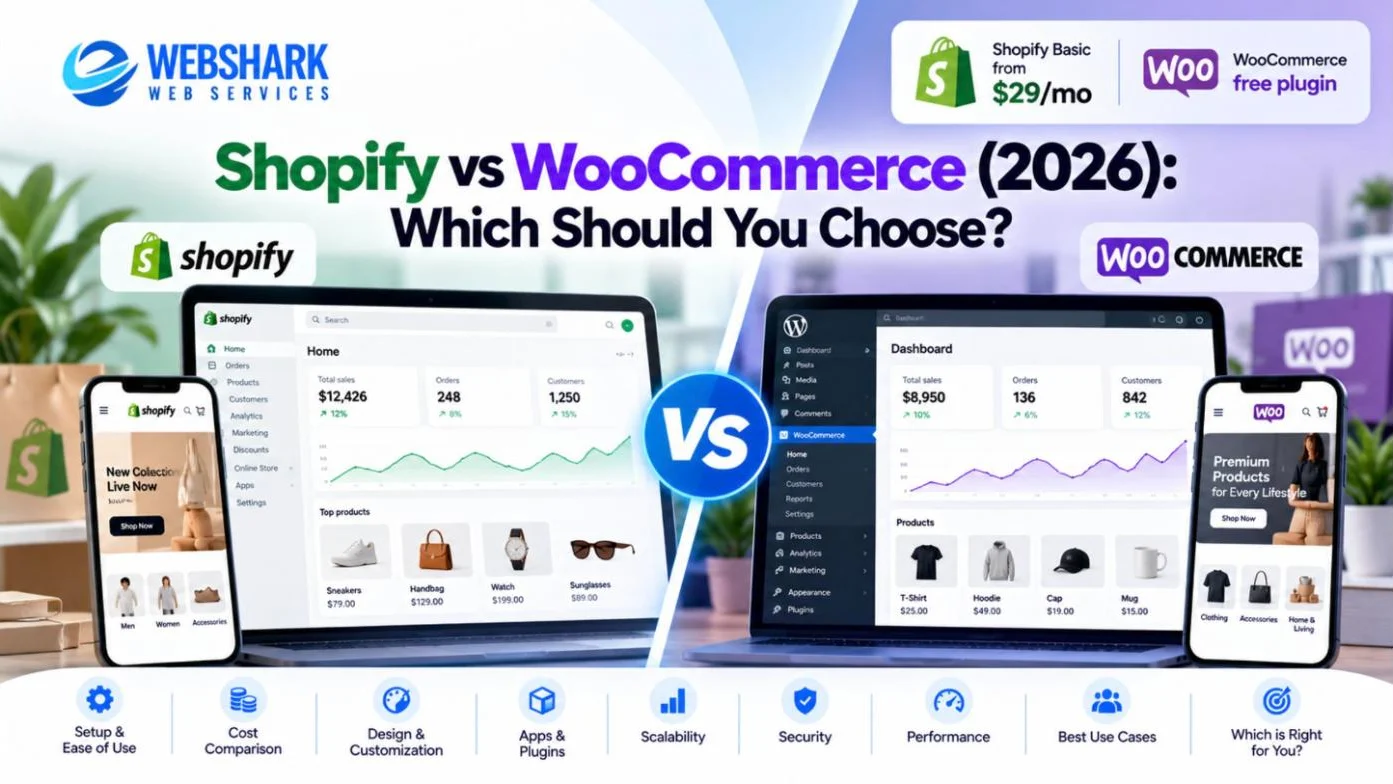

Shopify and WooCommerce are two of the most popular ways to build an online store. Shopify is an all-in-one hosted platform, while WooCommerce is a free, open-source plugin that turns a WordPress site into a store. Both can run successful businesses in 2026, but they suit different needs, budgets and teams.
This updated comparison covers ease of use, real costs, features, performance, security and scalability, so you can choose the right platform for your store.
Shopify and WooCommerce at a Glance
- Shopify: a hosted eCommerce platform. Hosting, security, updates and checkout are managed for you, and you pay a monthly subscription.
- WooCommerce: a free plugin for WordPress. You host it yourself, control everything and pay for hosting, extensions and maintenance.
WooCommerce is used by around 8% of the top one million eCommerce sites tracked by BuiltWith, according to Barn2, and it benefits from WordPress powering about 42.6% of all websites.
1. Ease of Use
Shopify is built for merchants who want to sell without managing technology. Setup is guided, and products, orders and payments are handled in one dashboard.
WooCommerce gives you more control but asks more of you: choosing hosting, installing and updating plugins, and managing backups and security, or working with a developer who does.
2. Cost and Pricing in 2026
Shopify’s main plans, as reported by Website Builder Expert in May 2026:
- Basic: USD 29 per month billed annually (USD 39 billed monthly)
- Grow: USD 79 per month billed annually (USD 105 billed monthly)
- Advanced: USD 299 per month billed annually (USD 399 billed monthly)
- Shopify Plus: from about USD 2,300 per month for high-volume brands
If you use a third-party payment gateway instead of Shopify Payments, Shopify adds a transaction fee of 2%, 1% or 0.6% depending on the plan. Paid apps and premium themes add to the total.
WooCommerce itself is free, but you pay for hosting, a domain, an SSL certificate (often included with hosting), premium extensions and ongoing maintenance. Costs are lower at small scale but grow with traffic and complexity. For local pricing, see our guides to Shopify development cost in India and eCommerce website development cost.
3. Features and Customization
Shopify covers most selling needs out of the box: products, inventory, discounts, multi-currency, a fast checkout and a large app store. Deep customization is possible with Liquid themes, apps and headless builds using Hydrogen.
WooCommerce offers almost unlimited flexibility because you control the code. It is ideal when you need unusual product types, complex pricing rules, B2B workflows or tight integration with content.
4. Performance and Scalability
Shopify handles hosting, CDN and traffic spikes for you, which makes it reliable during sales events without extra engineering.
WooCommerce performance depends on hosting quality, caching and plugin choices. It can scale well, but large catalogs and high traffic need good infrastructure and optimization.
5. Security and Compliance
Shopify is PCI DSS compliant and manages platform security and SSL for every store.
WooCommerce security is your responsibility: keeping WordPress, themes and plugins updated, using secure hosting, firewalls and backups, and choosing reputable payment gateways.
6. SEO and Content
Both platforms can rank well. WooCommerce benefits from WordPress’s strong content tools and SEO plugins, which is useful for content-led brands. Shopify has solid built-in SEO features and supports structured data through themes and apps.
Which Should You Choose?
- Choose Shopify if you want to launch quickly, prefer a managed platform, and would rather focus on marketing and operations than technology.
- Choose WooCommerce if you already use WordPress, need deep customization, want full ownership of your platform, or run a content-heavy store.
- Consider Magento (Adobe Commerce) if you have a very large catalog or complex B2B needs. See our Magento vs Shopify comparison.
Final Thoughts
Shopify trades some flexibility for simplicity and reliability, while WooCommerce trades simplicity for control. The right choice depends on your budget, technical resources and growth plans. Whichever you pick, invest in a fast, mobile-first store and a smooth checkout.
Webshark builds and optimizes both Shopify and WooCommerce stores. Explore our Shopify development services and eCommerce development, see our list of top Shopify development companies in India, or contact our team.